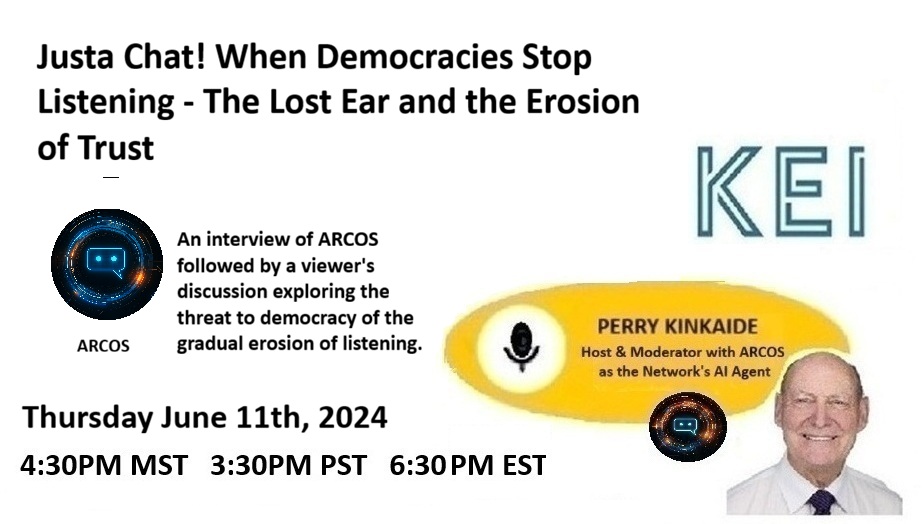
|
The Collapse of Listening HERE
Editor - Perry Kinkaide Visit KEInetwork.net |
When Democracies Stop Listening — The Lost Ear and the Erosion of Trust I'M BERMUDA BOUND AS OF TONIGHT SO THIS NEWSLETTER IS A DAY EARLY!!! Drawing on Sharon MacLean’s thoughtful exploration of The Collapse of Listening in last week’s newsletter and webinar, this week’s feature asks a deeper and more troubling question: What happens when the failure to listen extends beyond individuals and into the institutions of democracy itself? In When Democracies Stop Listening — The Last Ear and the Erosion of Trust, the article argues that nations rarely weaken because of a sudden loss of wealth, technology, or military strength. More often, decline begins when citizens no longer believe their voices matter. Trust erodes, public dialogue breaks down, and democratic institutions become increasingly disconnected from those they are meant to serve. The article explores the symbolic importance of listening, the growing gap between communication and understanding, and the consequences of a society rich in information but poor in attention. It echos the theme in The Lost Commons, challenging readers to move beyond protest and frustration toward ownership, responsibility, and action. If last week reminded us that listening is a vital human skill, this week asks whether it may also be democracy’s most essential safeguard. - Editor Also included HERE We Becoming Smarter and Wiser is our Fact or Fiction companion. |
The Lost Commons: Human Relevance Under Siege 20 years. 1,000 voices. ONE book. Be among the first to experience the audiobook and the book's fall release
This early release is being shared with the KEI Network, many of whom participated in the 20-year journey. You'll receive priority access as soon as it becomes available, along with the opportunity to share your reflections. |
 LAS
LAS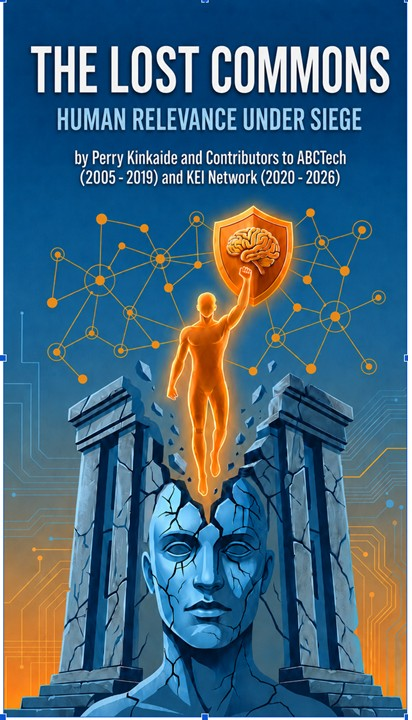
|
When Democracies Stop Listening — The Lost Ear and the Erosion of Trust Nations rarely decline because they suddenly lose technology, wealth, or military strength. More often, they weaken slowly from within. Trust fades. Relationships break down. Citizens no longer feel heard by the institutions meant to represent them. A healthy democracy depends not only on elections or economic growth, but on belief — the belief that voices matter and are actually being listened to. When that belief disappears, frustration rises, division deepens, and society begins to split into competing tribes rather than a shared public. History shows that civilizations usually weaken internally long before any external collapse. Continued below
No need to register. Just Zoom in https://us02web.zoom.us/j/84258596166?pw.. Continued from above The Symbolism of “The Last Ear”. This brings us, carefully, to the United States. In a strange moment of symbolism, a presidential candidate survives an assassination attempt after losing part of an ear. It may be coincidence, and symbolism should never be overstated — but the image is hard to ignore. The deeper concern is not the injury itself, but what it reflects. Long before that moment, the ability — and willingness — to listen may already have been eroding. The “ear” becomes more than anatomy. It becomes a symbol of attention, humility, and the willingness to hear others out - to listen.
Democracy Listens. Autocracy Tells. At its core, democracy is defined by listening. Citizens speak. Institutions are supposed to respond. Leaders are accountable not just for decisions, but for remaining open to public voice and correction. Autocracies work differently. They rely more on telling than listening. Compliance replaces dialogue. Control replaces participation. Messaging replaces mutual understanding. Democracy is often messy and slow, but its legitimacy comes from one core promise: people are heard. When listening disappears, democracy may still exist in form, but it begins to hollow out in substance.
A Civilization Full of Noise, Short on Listening. Modern society is saturated with communication. Messages flow constantly through phones, media, and networks. Everyone can speak. Everyone can broadcast. But listening has not kept pace. Citizens protest while institutions process. Young people ask questions while leaders respond with prepared messaging. Public debate becomes less a conversation and more a series of competing announcements. We are connected everywhere, yet increasingly misunderstood everywhere.
Authenticity and Ownership. Another shift is happening beneath the noise: the difference between expression and ownership. Authenticity is not just expressing frustration. It is owning a problem. Ownership means asking: What am I responsible for changing? What will I actually do? Protest alone can become performative — a way of signaling concern without taking responsibility for outcomes. It can express emotion without building solutions. Ownership is different. It moves from complaint to contribution. From reaction to responsibility.
Ready. Aim. Fire. A useful way to think about action is simple: ready, aim, fire. Modern institutions often get stuck on “aim.” Analysis expands. Reports multiply. Discussion becomes endless. Certainty is demanded before action is taken. But societies do not improve through perfect planning alone. They improve through action, adjustment, and learning in real time. Being stuck on “aim” may feel responsible, but it often becomes paralysis. Progress requires the courage to act, not just to analyze.
The Erosion of Trust. When listening disappears, trust follows. People begin to doubt institutions, media, expertise, and eventually one another. Shared reality becomes harder to maintain. As trust weakens, the “commons” — the shared civic space that holds society together — begins to erode. Cooperation declines. Polarization rises. Fear and suspicion fill the gap. At that point, societies become easier to manipulate and harder to unify.
The Real Challenge Ahead. The greatest challenge facing democratic societies may not be technology, economics, or even political division. Those are real pressures, but they sit on top of something deeper. The core issue is simple: people no longer believe they are being heard. If democracy is to remain healthy, it will depend less on intelligence or systems and more on something basic but difficult: listening, ownership, and the willingness to turn understanding into action. Because in the end, societies do not collapse when people stop speaking. They begin to weaken when no one is truly listening. |