|
LAST WEEK's WEBINAR The Concluding Reflections HERE Editor - Perry Kinkaide Visit KEInetwork.net |
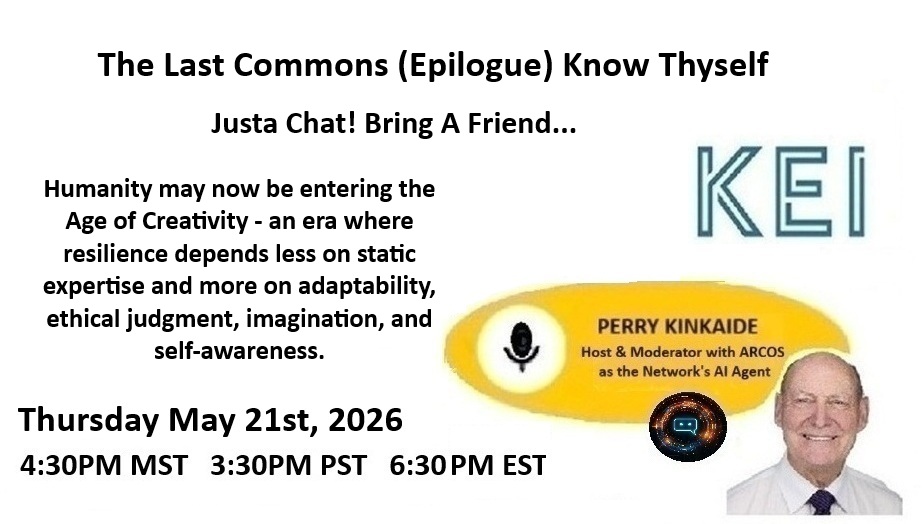
The Last Commons (Epilogue) Know Thyself This epilogue emerged from my growing conviction that amid accelerating technological change, we must rediscover the importance of self-awareness within a broader historical context. Civilizations have always been shaped not only by innovation, but by the character, judgment, and resilience of the people navigating periods of profound transformation.. - Author and Editor Also included HERE Voices in Your Head our Fact or Fiction companion. |
The Last Commons: Reclaiming Personal Sovereignty Twenty years. A thousand voices. One book. Be among the first to experience the audiobook edition of The Last Commons.
This early release is being shared with the KEI Network many who participated in the 20-year journey. You'll receive priority access as soon as it becomes available, along with the opportunity to share your reflections. |


|
The Last Commons (Epilogue) Know Thyself History rarely understands itself while it is unfolding. The Renaissance, the Enlightenment, and the Industrial Revolution all appeared chaotic and destabilizing to those living through them. Institutions weakened before new ones emerged, and old assumptions collapsed faster than society could adapt. The concluding epilogue to The Last Commons argues that our own era now stands at a similar turning point. Artificial intelligence, automation, biotechnology, quantum computing, and algorithmic systems are advancing faster than governments, professions, and even culture itself can fully comprehend. Public reaction swings between utopian optimism and dystopian fear. Yet the epilogue suggests the greatest risk is not technology alone, but humanity’s willingness to surrender judgment, responsibility, and self-awareness to systems we no longer fully understand. Continued below
No need to register. Just Zoom in https://us02web.zoom.us/j/84258596166?pw.. Continued from above At the centre of the article lies an ancient principle: know yourself. For centuries, knowledge represented power. Expertise was scarce, centralized, and controlled largely by institutions and professional elites. Artificial intelligence is now changing that equation. AI redistributes knowledge at extraordinary speed, placing tools once reserved for governments, corporations, and specialists directly into the hands of individuals. This creates remarkable possibilities. AI an improve education, medicine, research, entrepreneurship, and civic participation. Used wisely, it may strengthen both personal and civic sovereignty by helping individuals learn, create, and participate more meaningfully in society. But abundance also creates new dangers. When information becomes infinite, instantly accessible, and algorithmically amplified, the challenge is no longer simply acquiring knowledge. The challenge becomes learning how to govern ourselves wisely within systems designed to shape behaviour, capture attention, and encourage dependency. The epilogue argues that the defining question of the coming age is not whether AI will change civilization — it already is — but whether human beings will remain conscious participants in that transformation. Continued below
Please email Yogi to arrange a convenient date and time for him to pick up the items you have. Your help is appreciated. yogischulz@corvelle.com
Continued from above Drawing on historian Arnold Toynbee and his theory of “challenge and response,” the article suggests civilizations rise when they respond creatively and courageously to disruption, and decline when fear, complacency, or rigidity prevent adaptation. From this perspective, artificial intelligence represents less a technological crisis than a test of human maturity. The epilogue proposes that humanity may now be entering what it calls the Age of Creativity — an era where resilience depends less on static expertise and more on adaptability, ethical judgment, imagination, and self-awareness. Creation, in this sense, extends beyond art or invention. It includes building communities, renewing institutions, raising families, solving problems, and shaping cultures worthy of human dignity. The future will not be determined by algorithms alone, but by the character and intentionality of the people using them. Ultimately, the epilogue rejects both blind optimism and technological fatalism. A dystopian future emerges only if convenience replaces competence, efficiency replaces meaning, and dependence replaces independent judgment. Another path remains possible — one where intelligent systems strengthen rather than diminish human sovereignty. The Renaissance taught humanity to think. The age now emerging may require humanity to mature.
|

 Yogi Schulz - in Calgary, is seeking donations of used smartphones that many of us have at home and no longer use. He sends these smartphones to a friend in Africa who distributes them to students. Ideally, you will have the pass-code, the Apple ID or Android userid, and its password so that you can Erase all content.