The Last Commons (Chapter Three): The Illusion of Permanence
“Where there is no vision, the people perish.” — Proverbs 29:18
Prosperity carries a subtle danger. When success persists long enough, it begins to feel permanent. Systems built during times of abundance transform quietly—from engines of progress into guardians of the status quo. The institutions that once enabled growth begin to defend stability. What appears to be strength gradually becomes fragility.
Chapter Three of The Last Commons: Reclaiming Personal Sovereignty examines this condition through Alberta's recent history—not as a regional anomaly, but as an early warning system for advanced economies everywhere. The lesson is stark: prosperity can mask structural weakness for decades. Until the moment it cannot. Continued below

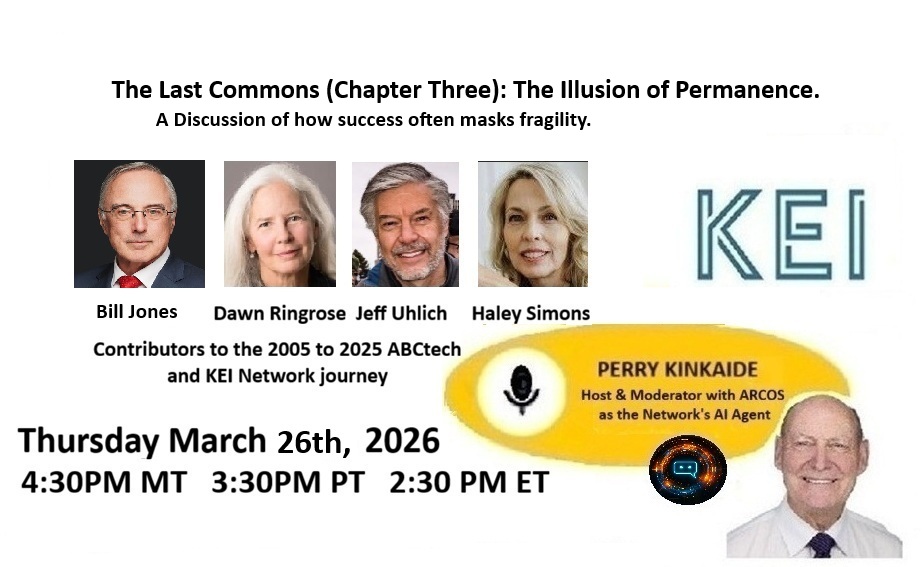
No need to register. Just Zoom in
https://us02web.zoom.us/j/84258596166?pw..
Continued from above
Alberta as Early Signal. The forces reshaping the global economy—technological disruption, regulatory strain, demographic shifts, and economic volatility—arrived in Alberta earlier than they did elsewhere. For decades, the province experienced extraordinary prosperity fuelled by one of the world's largest hydrocarbon reserves. That wealth created what seemed like a stable, successful, and repeatable economic model. But beneath that prosperity lay a dangerous assumption: that tomorrow would look very much like today.
During the 2015–2021 Economic Resilience Surveys conducted through the Alberta Council of
Technologies Society (ABCtech) and later the KEI Network, an uncomfortable pattern emerged. Public confidence in Alberta's economy tracked almost perfectly with oil prices. When prices rose, optimism surged and diversification became unnecessary. When prices fell, concern returned briefly—but hope persisted that the cycle would simply repeat. The province had become trapped in a repeating loop: prosperity masking fragility. The signals existed. They were simply ignored.
The Geological Subsidy. The phrase "Alberta Advantage" entered political language as an explanation for the province's prosperity. Low taxes, light regulation, and entrepreneurial spirit were credited with economic success. Yet the deeper truth was simpler: Alberta was fortunate. It sat atop one of the world's richest hydrocarbon deposits at the precise moment global demand surged. The advantage was geological.
This resource wealth created what might be called a geological subsidy—an external condition that allowed systems to appear stronger than they truly were. As energy revenues rose, nearly every sector of the economy became tied—directly or indirectly—to a single external variable. The economy appeared diversified. In practice, it was highly concentrated.
When commodity prices fluctuated, the entire psychological foundation of economic confidence moved with them. The problem was not ignorance. Evidence of vulnerability accumulated for years. Analysts, academics, and industry observers repeatedly identified the structural weakness. But institutions designed to preserve stability naturally resisted messages that threatened the status quo.
Fragility Beneath Prosperity. The central insight of Chapter Three is that fragility does not appear suddenly. It accumulates quietly. Institutions, professions, and governments operate under incentives that reward continuity rather than disruption. Leaders respond to immediate pressures while discounting future risks. Over time, the system evolves toward protecting existing arrangements rather than preparing for change.
This dynamic was visible across Alberta's innovation ecosystem. Surveys consistently revealed that while resources and infrastructure were relatively strong, the ecosystem suffered from deficits in vision, leadership, and relational coordination. Entrepreneurs struggled—not because capital was absent, but because the networks required to transform ideas into growing enterprises were underdeveloped.
The deeper challenge was cultural. Systems designed for stable conditions struggle to adapt when the environment shifts.
The Relational Deficit. One of the most revealing findings from ABCtech's research into why small and medium-sized enterprises fail to scale was that the constraint was rarely financial. The binding limitation was management capacity and relational infrastructure.
Marketing capability ranked highest among factors required for growth, followed closely by management expertise. Access to investors—often assumed to be the primary constraint—ranked last. Economic systems succeed not primarily because of resources, but because of the relationships and management processes that convert resources into outcomes. Where those relationships are weak, innovation stalls—even when funding and technology exist.
Institutional Resistance. The surveys also revealed a second pattern: the organizations created to support innovation had evolved cultures that inadvertently discouraged it. Government programes measured inputs rather than outcomes. Research systems rewarded publication more than commercialization. Policies emphasized stability rather than experimentation.
In such environments, reform becomes difficult precisely because the institutions responsible for change are structured to resist it. Fragility persists because many stakeholders benefit from its persistence.
The Regional Divide. A third pattern appeared across Alberta's two major metropolitan regions. Calgary—anchored in private-sector energy markets—tended to rate economic resilience higher and demanded less government intervention. Edmonton—dominated by government, health, and education institutions—consistently assessed resilience lower while advocating greater public action.
Both Regions faced identical economic shocks, yet their interpretations differed significantly. The difference lay in incentives. Market-exposed environments reward adaptation. Protected environments tend to emphasize stability. Over time, that protection can suppress the very instincts that generate resilience.
From Economic to Cognitive Fragility. While Chapter Three begins with economic resilience, it ultimately arrives at a deeper concern: cognitive sovereignty. The illusion of permanence that once surrounded resource wealth now surrounds the knowledge economy itself. For centuries, knowledge and professional expertise were the foundation of middle-class security. Artificial intelligence is beginning to challenge that assumption—at scale, and faster than most institutional frameworks were designed to absorb.
The same patterns that once masked economic fragility—overconfidence, institutional inertia,
resistance to uncomfortable evidence—are now emerging in the knowledge economy. Just as GDP failed to capture Alberta's vulnerability, traditional metrics may fail to capture a new form of fragility: the erosion of human agency in an age of intelligent machines.
The Cost Silence. Every chapter in The Last Commons identifies what it calls a Cost Silence—the price societies pay for ignoring uncomfortable truths. In Chapter Three, that cost is fragility itself. When systems suppress consequence, they delay adaptation. When success breeds complacency, learning stops. Over time, institutions continue functioning—but only by borrowing resilience from the future. Eventually the correction arrives. Alberta's experience suggests the stakes are far larger than one province or one industry. The illusion of permanence is not unique to resource economies. It is a recurring feature of human systems everywhere—and it always ends the same way: when the illusion fades, the work of rebuilding begins.
The question is not whether the illusion will fade. It is whether we recognize the warning signals in time—or continue believing that today's conditions are a permanent state of affairs.