|
LAST WEEK's WEBINAR The Institutional Antibody HERE Editor - Perry Kinkaide Visit KEInetwork.net |
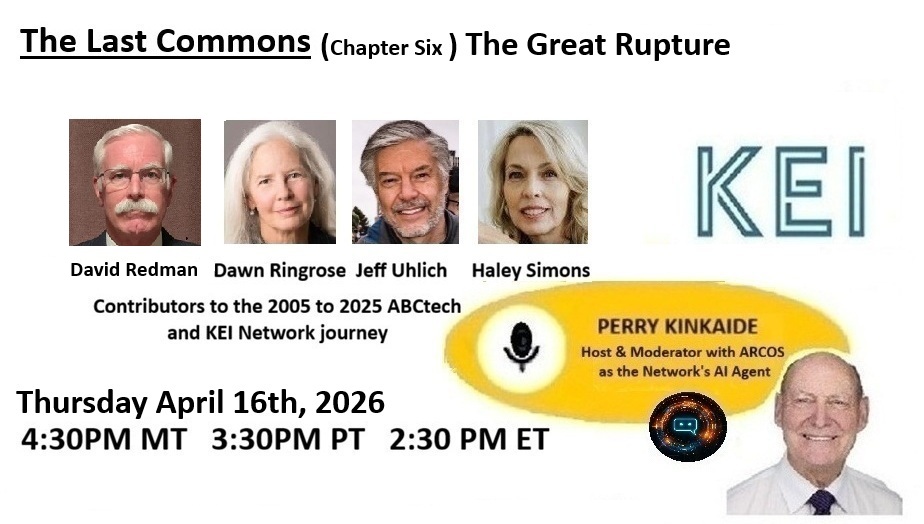
The Last Commons (Chapter Six): The Great Rupture What happens when the systems we rely on to guide us can no longer explain themselves? In the previous issue, we examined how institutions resist change—not through overt rejection, but through delay, diffusion, and the quiet filtering of ideas that do not fit established structures. That pattern held under conditions of relative stability, where time itself acted as a buffer. Chapter Six begins where that buffer disappears. The question is no longer whether institutions can adapt in theory. It is whether they can respond when conditions demand it—immediately, visibly, and without the protection of time. Also included HERE Alberta's Indigeneous Population Wants Out as our Fact or Fiction companion. — Editor |
The Last Commons: Reclaiming Personal Sovereignty Twenty years. Hundreds of voices. One book.
Reply to Editor@KEInetwork.net to join my early access listing for the book + audiobook |


|
The Great Rupture — When Systems Are Exposed The pandemic did not create institutional weakness. It exposed it. For years, systems had become increasingly adept at managing disruption by absorbing it—studying it, reframing it, and delaying its consequences. The Institutional Antibody described in Chapter Five had become highly refined. It could preserve form even as the environment shifted. But this capacity depended on one condition: time. When the pandemic compressed time—turning months into days and decisions into immediate consequences—the mechanisms that had once provided stability began to reveal their limits. What had been internal processes became public experience. The system did not fail suddenly. It became visible.
No need to register. Just Zoom in https://us02web.zoom.us/j/84258596166?pw.. Continued from above Delay Is No Longer a Strategy. Under stable conditions, delay can be mistaken for prudence. It allows institutions to maintain coherence while appearing to engage with change. Under crisis conditions, however, delay loses its protective function. The early months of 2020 illustrate this clearly. As case counts rose and borders closed, institutions continued to operate within familiar patterns—issuing guidance, refining positions, and managing communication. Yet the pace of events outstripped the pace of institutional response. What had once been manageable—deferring decisions, awaiting clarity—became untenable. The system could not keep up with the environment it was meant to interpret. When Communication Replaces Understanding. The most immediate signal of this shift was not operational failure, but communicative breakdown. Guidance evolved, as it should in uncertain conditions. Science is iterative. Evidence accumulates. Conclusions change. But what was missing was not accuracy—it was explanation. Positions shifted without acknowledgment. Earlier guidance was not reconciled with new direction. Uncertainty was not shared in a way that built understanding. The issue was not that institutions were wrong. It was that they behaved as though being wrong could not be admitted. Communication, in this context, ceased to function as a means of shared reasoning. It became a mechanism for managing behaviour. The public was not engaged. The public was handled. Credibility Becomes the Casualty. The central cost of this rupture is not measured in policy outcomes alone. It is measured in credibility. Trust is not lost when institutions encounter uncertainty. It is lost when they cannot explain that uncertainty in a way that preserves coherence. As the gap widened between what people were told and what they observed, confidence declined—not only in specific policies, but in the broader capacity of institutions to interpret reality. This erosion was not uniform, but it was cumulative. Each unexplained reversal, each inconsistency left unaddressed, contributed to a growing sense that the system was no longer reliable in the way it once had been assumed to be. The rupture, in this sense, was not new. It was revealed. When Process Is Replaced by Protection. A second shift occurred less visibly, but with deeper implications. Scientific disagreement—normally the mechanism through which knowledge is refined—became constrained. Alternative perspectives were not consistently engaged. They were often dismissed, labelled, or excluded. This was not a failure of science itself. It was a failure of institutional tolerance for uncertainty. When disagreement is suppressed rather than examined, the process that produces reliable knowledge is weakened. The system begins to prioritize alignment over inquiry, consensus over challenge. In doing so, it loses not only the diversity of thought required for adaptation, but the credibility that comes from demonstrating that such diversity can be meaningfully engaged. Policy Without Precision. The pandemic also exposed a more practical limitation: the inability to calibrate response to differentiated risk. From the earliest stages, it was evident that the impact of the virus was uneven—varying significantly across age groups, health conditions, and social contexts. Yet policy responses were often broad and undifferentiated, applied uniformly across populations with very different levels of exposure and consequence. The system demonstrated that it could act quickly. It did not demonstrate that it could act precisely. The result was a widening gap between policy intent and lived experience. For some, the measures aligned with immediate risk. For others, they imposed costs that were difficult to reconcile with their own circumstances. That gap did not remain abstract. It was experienced directly. The Economic Divide Comes Into Focus. At the same time, the economic consequences of the pandemic revealed a structural divide that had been developing for years. One segment of the economy adapted rapidly—enabled by digital infrastructure, supported by asset ownership, and increasingly detached from physical constraints. Another segment, dependent on physical presence and limited in flexibility, contracted sharply. The divergence was not temporary. It accelerated. Those positioned within digital and asset networks advanced. Those outside them absorbed disproportionate loss. The disruption did not distribute evenly. It followed the contours of an economy already shaped by uneven access to adaptability. When Trust Becomes the Limiting Factor. As the crisis evolved, the central issue shifted. It was no longer simply about the effectiveness of individual policies. It was about trust in the system itself. Confidence declined not in resources or infrastructure, but in leadership, process, and judgment. People could see the system under strain. They were less certain that those responsible could interpret that strain accurately, or respond to it effectively. The question changed. Not what should be done—but who could be believed. From Institutional Reliance to Personal Capacity. In response, behaviour began to shift. Individuals sought alternative sources of information. They relied less on centralized guidance. They formed smaller, more responsive networks capable of interpreting conditions in real time. This was not a rejection of institutions. It was an adjustment to their limits. Capacity began to migrate—not entirely away from institutional structures, but toward individuals and networks able to operate with greater speed and flexibility. The Condition That Remains. The trust deficit that emerged is not easily resolved. Not because of intent, but because of structure. The same incentives, governance models, and decision-making processes remain in place. The conditions that produced the rupture have not been fundamentally altered. They have been exposed. The implications extend beyond the pandemic—to technology, economic policy, and public discourse. The same dynamics—shifting messaging, constrained debate, uneven outcomes—are already visible in new domains. The Question That Follows. If institutions cannot be relied upon to communicate transparently, and if information environments cannot be relied upon to filter truth, then the question becomes more immediate. What remains within our control? Not certainty. Capacity. The ability to evaluate, to question, and to decide. The Arc — From System to Self. Chapter Five described systems that resist change. Chapter Six shows what happens when those systems are exposed to it. Together, they point to a shift already underway: Resilience is no longer institutional first. It is becoming personal. A Note to Our Network. The KEI Network exists to examine these forces and sources of change—not from the outside, but from lived experience across sectors. If these conversations are useful to you, consider supporting the Network. Your contribution helps maintain an independent voice committed to informed, provocative, and insightful dialogue. Visit KEInetwork.net And for those navigating these shifts directly—entrepreneurs, organizations, and leaders—our work extends beyond the newsletter. Over decades, the Network has been built to connect capability with need. If we can’t do it, we know someone who can. |

|
VISIT KEI Network Help sustain KEI's contributions |
KEI Network PATRONS  Bruce Clark
PROBUS of Central Edmonton
Edmonton Sunrise Rotary Club
|