|
LAST WEEK's WEBINAR The Sovereignty Stack HERE Editor - Perry Kinkaide Visit KEInetwork.net |
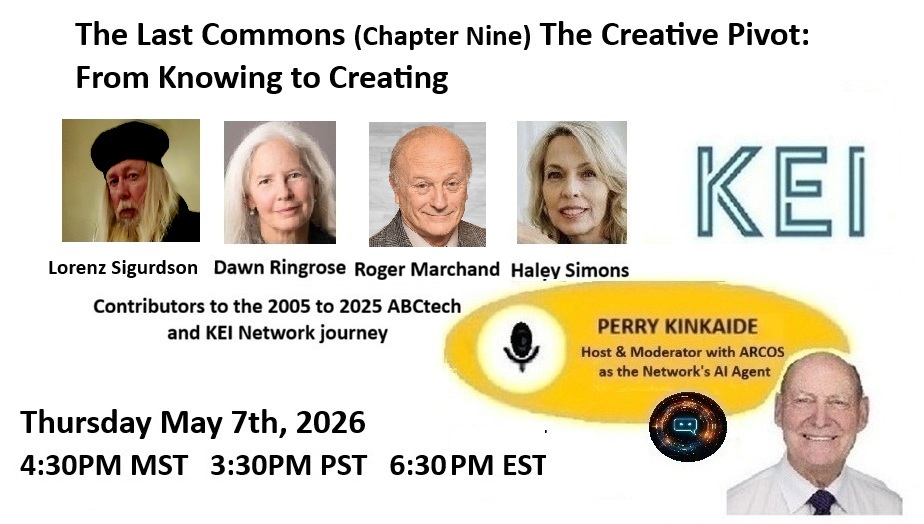
The Last Commons (Chapter Nine) The Creative Pivot: From Knowing to Intending Last week we examined the foundations of sovereignty through the tangible realities of energy, compute, and food—what enables the capacity to act. That discussion marked a critical transition: from understanding the infrastructure of independence to confronting how that capacity is directed. As the series moves from Chapter Eight to Chapter Nine, the focus shifts from systems to self. In this issue, we move from capability to intention - what sovereignty is ultimately for. As machines increasingly assume the work of knowing, the human role pivots toward judgment and creativity, ethics, and integrity. These are not abstract ideals; they are practical disciplines that shape decisions, define priorities, and determine consequences. The question now is no longer whether we can act independently, but whether we can act wisely—and in ways that sustain both individual purpose and the broader commons. - Editor Also included HERE Is the University of Alberta Acting with Integrity? our Fact or Fiction companion. |
The Last Commons: Reclaiming Personal Sovereignty Twenty years. A thousand voices. One book. Be among the first to experience the audiobook edition of The Last Commons. Register HERE
This early release is being shared with the KEI Network many who participated in the 20-year journey. You'll receive priority access as soon as it becomes available, along with the opportunity to share your reflections. |

|
The Creative Pivot: From Knowing to Intending “The work of ‘knowing,’ once our monopoly, is no longer uniquely human. What remains? Creativity.” — Perry Kinkaide For two centuries, modern economies rewarded those who knew. Knowledge was scarce, costly to acquire, and protected by institutions that certified who possessed it. Doctors knew medicine. Lawyers knew law. Engineers knew how systems worked. Credentials validated this knowledge, and professional associations guarded the boundaries of practice. That model is now being challenged. The arrival of generative artificial intelligence has not simply accelerated access to information—it has transformed access to interpretation. The internet allowed individuals to retrieve knowledge. Generative AI allows them to process and synthesize it instantly. In doing so, it challenges the foundations of the knowledge economy. The central question now confronting professionals, educators, and students is clear: What remains uniquely human when machines can perform the work of knowing? The answer may lie in what we might call the Creative Pivot. Continued below
No need to register. Just Zoom in https://us02web.zoom.us/j/84258596166?pw.. Continued from above The End of the Knowledge Monopoly. The knowledge economy rested on a stable assumption: specialized information had value because it was difficult to obtain. Years of education and certification created professionals whose expertise justified authority and compensation. Yet the warning signs appeared long before ChatGPT made them visible to the public. In 2016 - a decade ago, the Alberta Council of Technologies (ABCtech) asked a provocative question at a University of Alberta AI seminar: “The Beginning of the End of the Knowledge Economy?” The evidence was already accumulating. Analytics tools, mobile computing, and digital knowledge networks were eroding the monopoly of expertise. A survey conducted by ABCtech at the time found that 97 percent of professionals believed technology was changing client expectations. Clients were becoming consumers—expecting access, comparison, and transparency rather than deference to professional authority. The shift became unmistakable in November 2022 when generative AI tools such as ChatGPT entered public use. The internet democratized knowledge. Generative AI democratizes the processing of knowledge. Tasks once reserved for highly trained professionals—research, analysis, drafting, and synthesis—can now be performed in seconds. The competitor entering the professions does not attend university, obtain credentials, or join professional associations. It simply performs many of the same procedures faster and at scale. AI Masters “How.” Humans Retain “Why.” Jeff Uhlich, a contributor to KEI Network discussions on artificial intelligence and workforce transformation, captured the pivot succinctly: “AI masters how. Humans retain why.” Professional work traditionally combines two elements:
AI systems excel at procedures. They are trained on centuries of documented human knowledge—legal briefs, scientific papers, consulting reports, and technical manuals. From this data they learn patterns and reproduce professional outputs with remarkable speed. But procedures alone do not determine value.
These are not procedural tasks. They are acts of judgment. As Uhlich observes, the future of human work is not competing with machines on speed but complementing them with vision, discernment, and purpose. The economic shift is therefore profound. Where the knowledge economy rewarded those who executed procedures, the emerging economy rewards those who set direction—those who determine what procedures should serve. Execution becomes automated. Intention becomes human. The Credentialism Trap. This shift places enormous pressure on the institutions built to sustain the knowledge economy—especially universities. For generations, higher education has sold credentials that certify procedural competence. Medical schools train doctors to diagnose and treat. Law schools train lawyers to research and argue. Business schools train managers to analyze and recommend. But AI increasingly performs many of these procedures more efficiently. The result is a growing credentialism trap. Students invest years and accumulate debt acquiring procedural capabilities that machines can replicate in seconds. Universities continue producing degrees designed for an economy that is rapidly changing. Some credential holders will adapt, using their education as a foundation for judgment and leadership. Others may discover that the procedures their credentials certify have become commoditized. The dividing line is becoming clear:
The credentials that will matter most in the future may be those that certify intentional capacity—judgment, creativity, and synthesis. Such credentials, however, are still largely absent from today’s institutional structures. What Cannot Be Automated. The creative pivot does not eliminate work. It transforms its nature. Machines excel at combining information and exploring known conceptual spaces. Humans retain the rare capacity to transform those spaces entirely—to imagine possibilities that do not yet exist. This human capacity includes imagination, judgment, meaning, and intention. It emerges from experience, reflection, and the inner voice that evaluates what is worth pursuing. The KEI Network has often described this discipline through the metaphor of “hardening off.” Gardeners know that seedlings raised indoors must gradually adapt to outdoor conditions. Without that transition, they remain fragile and dependent. Minds that outsource every task to automation risk the same fate. Minds that use AI while maintaining independent judgment develop resilience. Dependency weakens. Discipline strengthens. Creativity as an Economic Force. The shift toward creativity is not merely philosophical. It is economic. Modern economies increasingly depend on intangible assets—ideas, design, intellectual property, networks, and cultural innovation. These forms of value arise not from mechanical production but from human imagination. The industrial economy rewarded efficiency and scale. The emerging economy rewards creativity and direction. As John Cleese once remarked, creativity rarely follows a linear path. It often begins without knowing exactly where one is going. That uncertainty—so uncomfortable in procedural work—is precisely where discovery occurs. The Bridge to the Commons. The Creative Pivot suggests a new definition of human value in an age of artificial capability. Knowing alone is no longer enough. The human premium shifts from information to imagination, from procedure to intention. Yet intention exercised in isolation remains private preference. The purposes that shape societies—how technology is used, how economies evolve, how freedoms are preserved—must be debated and refined collectively. They require spaces where independent thought can meet, challenge, and develop shared direction. The KEI Network calls such spaces The Last Commons. In an age where machines increasingly execute our procedures, the enduring human role may be simpler and more demanding at the same time: To imagine, to judge, and to decide what the future should become. A Note to Our Network. The KEI Network exists to examine these forces and sources of change—not from the outside, but from lived experience across sectors. If these conversations are useful to you, consider supporting the Network. Your contribution helps maintain an independent voice committed to informed, provocative, and insightful dialogue. Visit KEInetwork.net And for those navigating these shifts directly—entrepreneurs, organizations, and leaders—our work extends beyond the newsletter. Over decades, the Network has been built to connect capability with need. If we can’t do it, we know someone who can. |

|
VISIT KEI Network Help sustain KEI's contributions |
KEI Network PATRONS  Bruce Clark
PROBUS of Central Edmonton
Edmonton Sunrise Rotary Club
|