|
LAST WEEK's WEBINAR The Illusion of Permanence HERE
Editor - Perry Kinkaide Visit KEInetwork.net |
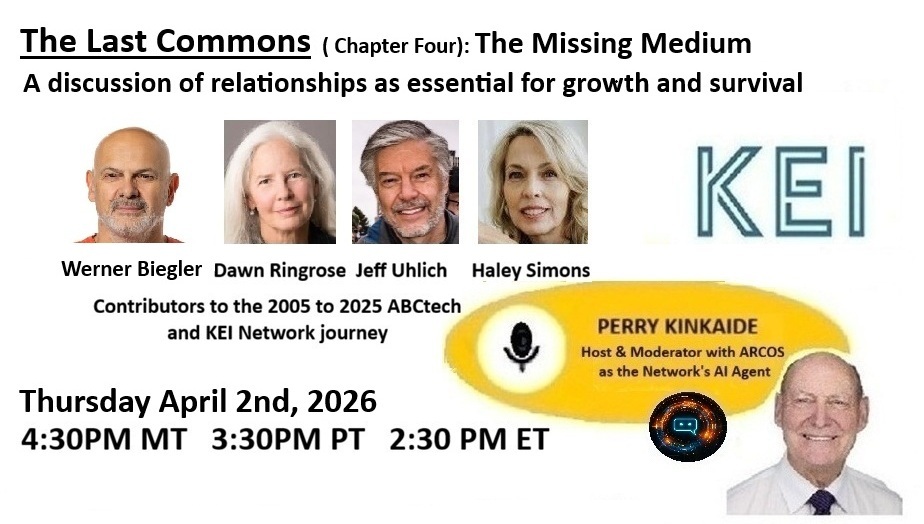
The Last Commons (Chapter Four): The Missing Medium We turn in this issue to Chapter Four of The Last Commons—a chapter that challenges one of the most deeply held assumptions in economic and innovation policy: that capital is the primary constraint on progress. It is not. What emerges instead is a more uncomfortable truth. Across decades of investment, the real gap was not financial, but relational. Ideas existed. Funding existed. Infrastructure existed. What was missing was the connective tissue—the human capacity to align, trust, and act together. This reframing has profound implications. It recasts the “Valley of Death” suffered by early-stage start-ups and their entrepreneurs not as a funding shortfall, but as a failure of transition, coordination, and capability. It exposes how well-intentioned systems—particularly those driven by grants and metrics—can inadvertently reward activity over outcome. And it points to a deeper deficit now emerging in the age of AI: not just a missing “M” for management, but a missing capacity for meaning. If there is a thread running through this chapter, it is this: progress is not a product of systems alone. It is a function of relationships.
Also included HERE Start-ups Fail Because They Lack Financing as our Fact or Fiction companion. — Editor |
|
he Last Commons (Chapter Four): The Missing Medium
“If an idea is shared in a bar and never leaves, is it real?” There is a persistent myth in economic development that success hinges on capital. That if only enough funding, technology, or intellectual property were applied, innovation would naturally translate into prosperity. Chapter Four of The Last Commons challenges that assumption directly—and decisively. The evidence suggests something far more uncomfortable: the constraint was never money. It was never ideas. It was never even technology. The constraint was relational.
When Capital Was Not the Problem. Across Alberta’s innovation landscape, billions were invested in research, infrastructure, and early-stage ventures. Universities produced world-class discoveries. Governments funded programs with ambition and intent. Yet the commercial outcomes consistently fell short. Why? Because ideas do not move themselves. They require people—aligned, capable, and connected—to carry them from concept to reality. Continued below
No need to register. Just Zoom in https://us02web.zoom.us/j/84258596166?pw.. Continued from above The Missing “M” in SMEs—management—was not simply a technical gap. It was a deeper absence of relational capacity: the ability to build trust, coordinate effort, communicate value, and navigate complexity. Entrepreneurs themselves made this clear during consultations across the province. Growth depended not on access to capital, but on relationships—with customers, teams, suppliers, and mentors. In short: knowledge without relationships has no value.
The Valley of Death Is Human, Not Financial. The so-called “Valley of Death”—long described as the funding gap between research and commercialization—turns out to be something else entirely. It is a relational gap. Companies do not fail simply because they lack capital. They fail because they cannot transition between stages of growth. Founders who can invent cannot always manage. Those who can sell cannot always scale. Each stage demands new capabilities, and without the relational infrastructure to support that evolution, progress stalls.
Even high-growth firms—only about 6% of the total—struggle to cross these thresholds. The issue is not product viability. It is human capability. This reframing matters. If the problem is misdiagnosed as financial, the solution will always be more funding. And that is precisely what happened.
The Grant Trap. Public innovation systems, designed to stimulate economic growth, have instead created what this chapter calls the Grant Trap. Grants reward activity, not outcomes. They prioritize compliance over impact. They select for those who can navigate bureaucratic processes—not those who can build viable businesses. The result is predictable:
The example of nanotechnology investment is telling. Over a billion dollars flowed into research infrastructure, producing papers and patents—but no meaningful market impact. The system worked exactly as designed. It simply wasn’t designed for the outcome it claimed to pursue.
Fragmentation Without Coordination. This pattern extends beyond business into the broader institutional landscape. Government programs multiply. NGOs proliferate. Universities expand research output. Yet coordination remains weak, and accountability diffuse. Each actor operates within its own mandate, incentivized to survive and grow—but not necessarily to collaborate or align. The result is fragmentation:
What is missing is not goodwill or intelligence. It is the infrastructure of relationships—the connective tissue that allows systems to function as systems.
The Convenor Model: Rebuilding the Medium. If the problem is relational poverty, the solution must be relational architecture. This is where the Convenor Model emerges. Rather than focusing on funding or control, convenors focus on connection. They create environments where people who need each other can find each other. They build trust without hierarchy and coordination without bureaucracy.
ABCtech operated in this way—bringing together entrepreneurs, researchers, investors, and policymakers in structured but informal settings. The goal was not to deliver content, but to catalyze relationships. The outcomes were not immediate or easily measurable. But they were real:
Trust, not capital, became the currency. And perhaps most importantly, these environments were human—spaces where individuals felt heard, engaged, and connected. The informal “Justa’ Chat” gatherings, sustained over decades, exemplify this principle: that meaningful progress often begins not with programs, but with conversations.
From Missing M to Missing Meaning. What began as a regional economic insight now scales to a broader civilizational challenge. As artificial intelligence transforms the knowledge economy, the same pattern re-emerges. The skills that once defined professional value—analysis, synthesis, communication—are increasingly automated. What remains? The human capabilities that were always undervalued:
The “Missing M” has evolved into something deeper: a missing capacity for meaning in a world of abundant information. The Valley of Death is no longer just economic. It is existential.
The Lesson. The central lesson of Chapter Four is both simple and profound: Systems do not fail at their financial edges. They fail at their human seams. We have spent decades investing in what is visible—capital, technology, infrastructure—while neglecting what is essential but less tangible: relationships, trust, and coordination.
The Commons, as a living concept, offers a path forward. Not as nostalgia, but as necessity. A space where individuals can reconnect, deliberate, and act outside the constraints of transactional systems. In the end, the bridge between invention and impact is not built with money. It is built with people.
|

|
VISIT KEI Network Help sustain KEI's contributions |
KEI Network PATRONS  Bruce Clark
PROBUS of Central Edmonton
Edmonton Sunrise Rotary Club
|