|
LAST WEEK's WEBINAR Dehumanizing the Public HERE Editor - Perry Kinkaide Visit KEInetwork.net |
The Last Commons: A Final Reflection Before the Journey Begins Last week, in "Fear for Sale: The Attention Economy and the Dehumanization of the Public", we argued that fear has migrated from staged spectacle to ambient algorithm. The public is no longer merely informed; it is harvested. This is a Diagnosis. Attention has become currency. Anxiety has become fuel. And the sovereign self is increasingly reduced to a metric. What now follows is the Response. We ask what remains when identity is mediated, quantified, and publicly validated. When algorithms predict personal desire and institutions reward conformity — reinforced by post-modern cultural narratives and neo-liberal governance models that elevate performance and alignment — where does the unconditioned self stand? This is not an anti-institutional or anti-technology argument. It is a recognition that technological acceleration has converged with political and cultural forces that privilege the public persona over the private conscience. Citizenship becomes performance. Authenticity becomes strategic. The measurable self gradually displaces the reflective one. |
|
The Commons, as proposed here, is a space where sovereign individuals gather without dissolving into uniformity — where disagreement is permitted and interior judgment is not outsourced. If the attention economy dehumanizes by selling fear, The Last Commons asks whether we are prepared to restore sovereignty — not as isolation, but as the foundation of genuine community. Also included HERE is You've Lost Your Mind as our Fact or Fiction companion. — Editor |
|

|
The Last Commons: A Final Reflection Before the Journey Begins Before we begin publishing the 10 episodes of The Last Commons, let's pause. This pause matters. We are living in a moment of acceleration — technological, political, cultural. Artificial intelligence is no longer speculative. Biotechnology is no longer distant. The architecture of influence is no longer subtle. In works like Homo Deus: A Brief History of Tomorrow, the author Yuval Noah Harari explores the possibility that AI and biotechnology may lead us toward a transhuman future — one in which the human organism itself becomes a design project. He warns not only of enhanced elites or algorithmic authority, but of something quieter and perhaps more profound: The erosion of the sovereign self. Continued below
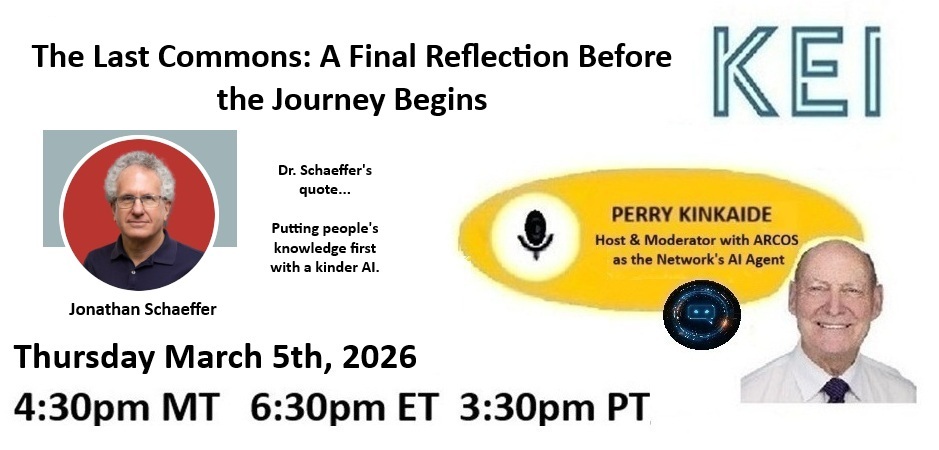
No need to register. Just Zoom in https://us02web.zoom.us/j/84258596166?pw.. Jonathan Schaeffer is the Founder and CEO of Synsira Software Solutions Inc. Think of all the concerns you have with AI large language models. If only we could eliminate them. Putting people’s knowledge first with a Kinder AI. Continued from above Harari describes a world in which data systems may come to know us better than we know ourselves. Algorithms predict desire, shape preference, and increasingly mediate identity. In such a world, the internal compass — the private self — risks being displaced by the quantified, publicly validated self. But the technological shift is only part of the story. Long before AI, modern institutions — educational, bureaucratic, corporate, even civic — began conditioning individuals toward homogeneity. The public self has gradually been elevated above the personal self. Conformity is rewarded. Divergence is softened. Authenticity is curated. The individual is subtly shamed for not aligning with institutional narratives. Sovereignty becomes reframed as selfishness. Independent thought becomes reframed as disruption. We are encouraged to merge.
And in doing so, something essential is muted. The Last Commons argues that there must remain a space — physical, intellectual, moral — where the personal self is not conditioned but deconditioned. A place where one can examine the narratives imposed by systems and ask: Is this truly mine? The Commons, as I describe it, is not a collective hive nor a homogenizing forum. It is a In the Commons, disagreement is not heresy.
If transhumanism seeks to optimize humanity, The Commons seeks to preserve it. If public systems press toward uniformity, The Commons protects plurality. If the age of AI tempts us to outsource judgment, the Commons invites us back to interior sovereignty. The ten chapters that will follow over the next several weeks are not prescriptions. They are provocations. They ask whether we are prepared to defend the dignity of the personal self in an era that increasingly privileges the measurable public self. This is not a rejection of technology. It is not a rejection of community. It is a reminder: A healthy society is not built by dissolving the individual into the collective. It is built when sovereign individuals freely choose to gather. That is The Last Commons. And it begins now. |

|
VISIT KEI Network Help sustain KEI's contributions |
KEI Network PATRONS  Bruce Clark
PROBUS of Central Edmonton
Edmonton Sunrise Rotary Club
|