|
LAST WEEK's WEBINAR Interview Jonathan Schaeffer HERE Editor - Perry Kinkaide Visit KEInetwork.net |
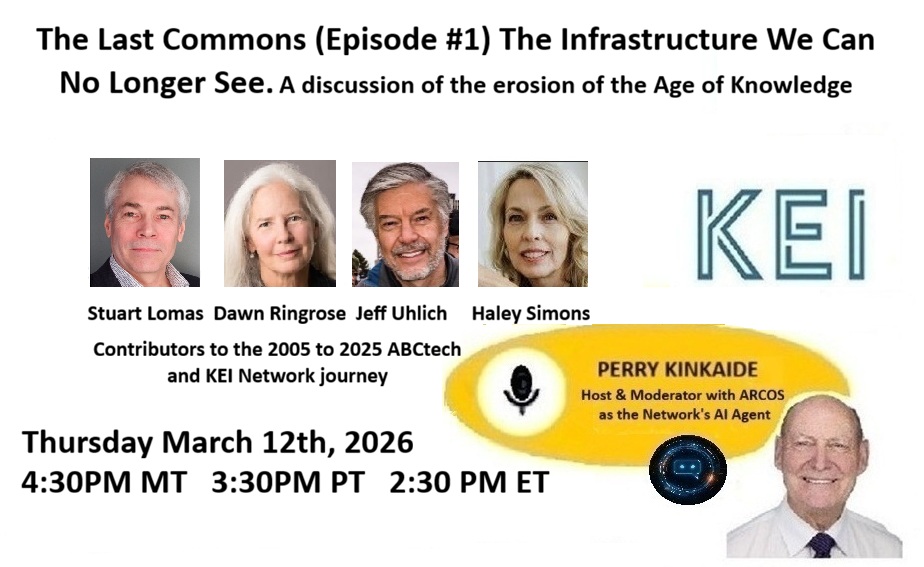
The Infrastructure We Can No Longer See (Episode #1 - The Last Commons) Editor’s Introduction – The Path to the Present Over the past several weeks, we have been exploring an unsettling possibility: that the greatest threat to human sovereignty may not come from distant adversaries or visible institutions, but from a gradual erosion of the self. Our capacity to think independently, to reflect critically, and to act with intention is increasingly shaped—if not quietly captured—by systems designed to attract, measure, and monetize our attention.
The devices we carry - our cell phone, promise connection, knowledge, and efficiency. Yet they also concentrate influence in ways that blur the line between assistance and dependency. When algorithms anticipate our desires, filter our information, and guide our reactions, the question arises: how much of our judgment remains truly our own?
In response, we introduced the idea of the Commons—not as nostalgia for a pre-modern past, but as a living space where individuals retain the ability to think, deliberate, and engage outside the pressures of algorithmic amplification. The Commons represents the cultural and civic ground where personal sovereignty and shared responsibility meet. |
|
With this issue and the associated webinar, we begin a deeper exploration. How did a civilization that once celebrated independent judgment arrive at a moment when attention itself has become the most contested resource?
Episode #1 is both historical and philosophical. It traces humanity’s long arc from an Age of Faith, through an Age of Reason, and toward a new and still-uncertain era shaped by technologies that increasingly mediate perception itself. Understanding how we arrived here is not an academic exercise. It is preparation. For the question now facing every society is not simply what technology will do next—but what kind of human beings we intend to remain.
Also included HERE is Human: The New Agents of AI as our Fact or Fiction companion. — Editor |
|

|
The Infrastructure We Can No Longer See (Episode #1. The Last Commons) Illusion: When Success Becomes Blindness
We rarely notice the systems that hold us together—until they begin to fail. Every age builds an infrastructure so complete, so embedded in daily life, that it becomes invisible. Roads, institutions, professions, habits of thought, and shared assumptions form a web that organizes meaning and power. Over time, that web becomes indistinguishable from reality itself. We stop seeing it as constructed. We experience it as permanent.
History suggests otherwise. In the age of faith, religion was not merely belief—it was infrastructure. Churches and cathedrals stood at the physical and symbolic center of communities. Education, charity, governance, and legitimacy flowed outward from them. The system endured for centuries not because it was abstract, but because it was materially embedded: payrolls, property, ritual, and authority reinforced belief daily. Continued below
No need to register. Just Zoom in https://us02web.zoom.us/j/84258596166?pw.. Continued from above Then came the Enlightenment. Reason did not simply challenge faith; it replaced one infrastructure with another. Universities supplanted monasteries. Laboratories, courts, hospitals, and bureaucracies became the new sacred spaces. Credentialing replaced ritual. Expertise replaced doctrine. The knowledge commons became the organizing framework of modern life.
The knowledge economy did not float above society—it structured it. Careers, pensions, social status, and institutional legitimacy were all tied to the assumption that human knowing creates value. The educated individual became both the beneficiary and guarantor of progress. And like faith before it, the knowledge infrastructure succeeded so completely that it stopped examining itself.
Success became blindness. Institutions built to preserve and transmit knowledge are structurally resistant to acknowledging that knowledge itself might be losing its scarcity. When a system works—when it delivers prosperity, authority, and social order—there is little incentive to question its foundations. Signals of misalignment are interpreted as threats rather than information.
We have seen this pattern before. In Alberta, prosperity tied to hydrocarbon wealth created a similar illusion of permanence. For decades, economic cycles reinforced the belief that growth would return, that downturns were temporary, that the future would resemble the past. Institutions did what institutions are designed to do: protect stability. Evidence that contradicted that stability was marginalized or deferred. The pattern was not moral failure. It was structural inertia. Today, a different infrastructure faces a similar moment.
Artificial intelligence does not merely introduce new tools into the knowledge economy. It challenges its organizing logic. When diagnosis, analysis, composition, prediction, and even decision-making can be performed at scale by systems that do not attend school, acquire credentials, or join professional associations, the economic and cultural justification for many institutions weakens.
The danger is not technological. It is architectural. The schools, regulatory bodies, professional hierarchies, and administrative systems that formed the backbone of the knowledge commons remain imposing. But their internal logic is being quietly uncoupled from their original function. As happened with religious institutions centuries earlier, form persists even as organizing belief erodes. When infrastructure outlives its logic, collapse is rarely dramatic at first. It manifests as drift—ritual without meaning, credential without authority, consultation without influence.
Participation becomes ceremonial. The illusion of permanence is powerful because it feels responsible. To defend established institutions is framed as prudence. To question foundational assumptions is framed as disruption. Yet history shows that the greater risk lies in mistaking continuity for resilience.
Resilience requires contact with reality. The knowledge commons produced extraordinary advances in medicine, governance, engineering, and human rights. But its endurance depends on whether human agency remains central within it. If understanding becomes optional, if decision-making becomes automated, if judgment is outsourced to systems optimized for efficiency rather than wisdom, then the commons risks becoming ornamental.
Artificial intelligence is not a monster. It is a mirror. It reflects the values we encoded, the metrics we rewarded, the attention culture we tolerated. It amplifies the patterns already embedded in our institutions. If the reflection troubles us—bias, manipulation, fragility—we are not witnessing alien behaviour. We are seeing our own architecture operating at scale.
This series begins from a simple premise: systems built by human choice can be examined and reshaped by human judgment. The question is not whether technology will advance. It will. The question is whether we will recognize when an age has shifted—whether we will detect the moment when infrastructure no longer aligns with purpose. Every civilization believes its organizing system is permanent. None have been correct.
The journey from illusion to sovereignty begins by seeing what we have stopped seeing. |

|
VISIT KEI Network Help sustain KEI's contributions |
KEI Network PATRONS
 Bruce Clark
PROBUS of Central Edmonton
Edmonton Sunrise Rotary Club
|