|
Editor - Perry Kinkaide Visit KEInetwork.net |
The Gathering Storm: Why Waiting Has Become The Most Dangerous Policy Last week was tumultuous—and there is little confidence that the days ahead will be calmer. Protesting, long regarded as a legitimate and even necessary expression of public discontent, is increasingly crossing a troubling threshold. What was once civic pressure is, in many places, sliding into confrontation and violence. The line between protest and disorder appears to be blurring, raising uncomfortable questions about what we are beginning to accept as “normal.” At the same time, our institutions appear strained and uncertain—slow to respond, reluctant to adapt, or perhaps simply fatigued by repeated waves of disruption. Are they unable to change, or unwilling to weather the inevitable turbulence that accompanies social and economic transition? These are not questions best answered in the heat of the streets. This week, through our featured article and Thursday’s webinar, we step back to examine what is happening, why it matters, and what it signals about the resilience—or fragility—of democratic societies. We will be watching closely, thinking critically, and exploring these issues together—virtually, thoughtfully, and without slogans. |
|
Conversations about the forces and sources of change will continue to be a prime focus of our newsletters and webinars. Our Fact or Fiction feature this week challenges the perspective that All Come in Time to Those Who Wait, or that Patieince is A Virtue. HERE Your views are always welcome. So please consider sending us an article to share and joining our Justa Chat webinars every Thursday. - Editor |
|

|
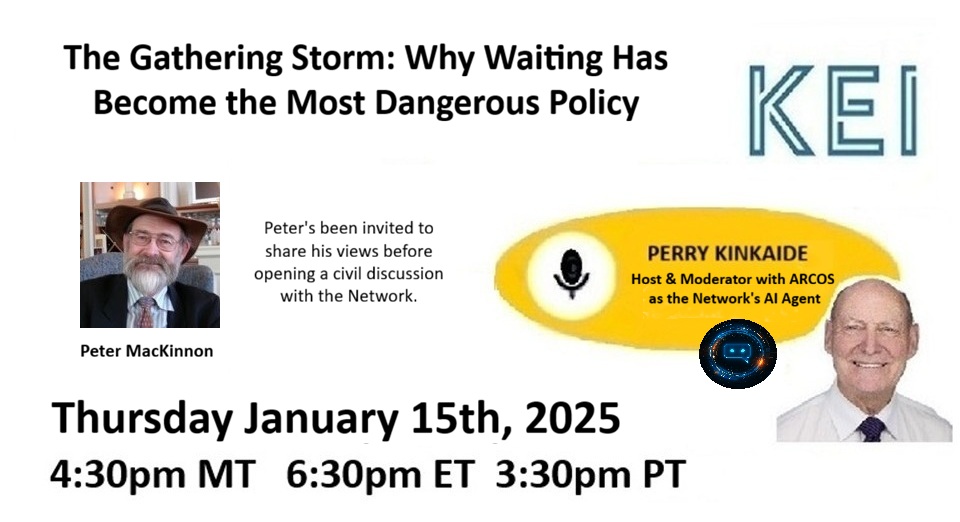
The Gathering Storm: Why Waiting Has Become the Most Dangerous Policy This past week, two forces dominated public attention. One arrived loudly and visibly—protests spreading across nations and cities. The other moved quietly, almost unnoticed—renewed talk of diversification, long deferred and suddenly urgent. At first glance, these appear unrelated. One is social, emotional, disruptive. The other is economic, technical, procedural. But beneath the surface, both are driven by the same underlying cause: excessive delay in decision-making. Governments across democratic societies have grown adept at managing reaction while postponing structural change. Short election cycles, polarized electorates, and fear of voter backlash have encouraged a style of governance that services symptoms rather than addresses causes. The result is mounting pressure. Continued below
No need to register. Just Zoom in https://us02web.zoom.us/j/84258596166?pw..Peter MacKinnon is a global management consultant and academic with experience spanning science, entrepreneurship, government, diplomacy, and executive leadership. His work focuses on science, technology, and innovation policy, digital transformation, Smart Cities, and advanced ICTs, with clients worldwide. He lectures on the environmental polycrisis and governance challenges, and researches the intersection of engineering, business, and disruptive technologies. MacKinnon has advised on AI, quantum technologies, SMRs, hydrogen, workforce development, and ethics. A pioneer in AI commercialization and Canada’s internet development, he has held senior academic, policy, and advisory roles internationally, including at the OECD and leading global technology integrity initiatives. Continued from above Protest: Political Weather, Not the Climate. Protests rarely signal novelty. They signal accumulation. From nationwide unrest in Iran HERE to city-level upheaval in Minneapolis, the pattern is familiar. Longstanding grievances—economic, social, institutional—were visible for years before they erupted. What changed was not awareness, but tolerance.
Housing affordability, access to justice, policing, education relevance, cost-of-living pressures, and institutional rigidity had all been debated extensively. Yet repeated deferral turned solvable problems into symbols of indifference.
Protest, in this sense, is not the cause of instability. It is the weather event produced by a system that has absorbed too much heat for too long. Early, credible action dissipates pressure quietly. Delay allows it to organize.
Diversification: Canada and Alberta at the Crossroads. Diversification is often framed as a long-term aspiration. For Canada—and particularly Alberta—it is now a matter of near-term resilience.
Energy markets are entering a period of structural change. Global supply is shifting, technologies are advancing, regulatory regimes are tightening, and market demand is fragmenting. The re-entry and expansion of production from countries such as Venezuela—and potentially Iran—will inevitably alter competitive dynamics, pricing pressure, and geopolitical leverage.
Canada’s oil and gas sector will adapt; that is not in doubt. The question is whether adaptation is proactive or forced. For Alberta, diversification does not mean abandoning energy. It means ensuring that markets are secure, relationships are durable, and the broader economy is sufficiently diversified to absorb shocks arising from:
Regions that diversify early do so deliberately, incrementally, and with public consent. Those that wait are compelled to diversify under stress—when margins are thinner, options fewer, and public confidence weaker. What could have been managed transition becomes emergency response. The lesson is consistent: diversification delayed does not disappear—it arrives suddenly, at far higher cost.
The Common Driver: Reluctance to Use Legitimate Authority. At the heart of both protest and economic fragility lies a deeper issue: governments have grown reluctant to use their legitimate regulatory authority early, prudently, and transparently. Policies designed to avoid shock may preserve calm temporarily. Policies designed to avoid change itself compound risk. This pattern is increasingly visible:
In climate terms, governments monitored rising temperatures while debating whether intervention might be unpopular.
From Democratic Evolution to Forced Correction. Here lies the real danger. When democratic systems consistently delay adaptation, citizens conclude—often correctly—that those systems are incapable of acting in time. Pressure then shifts from reform to rupture. Calls for stronger measures grow louder. Exceptional responses begin to feel justified.
This is how democratic evolution gives way—not suddenly, but gradually—to coercive correction. History is unambiguous: democracies fail not because they act too decisively, but because they act too late.
The Question Before Us. The choice is no longer whether change is coming. It is whether it will be shaped deliberately—or imposed by circumstance. Waiting once felt prudent. Today, it is the riskiest policy of all. |

|
Former KEI Network Help sustain KEI's contributions |
KEI Network PATRONS TroyMedia
Bruce Clark
PROBUS of Central Edmonton
Edmonton Sunrise Rotary Club
|