|
LAST WEEK's WEBINAR UFOs and Unexplainable Experiences HERE Editor - Perry Kinkaide Visit KEInetwork.net |
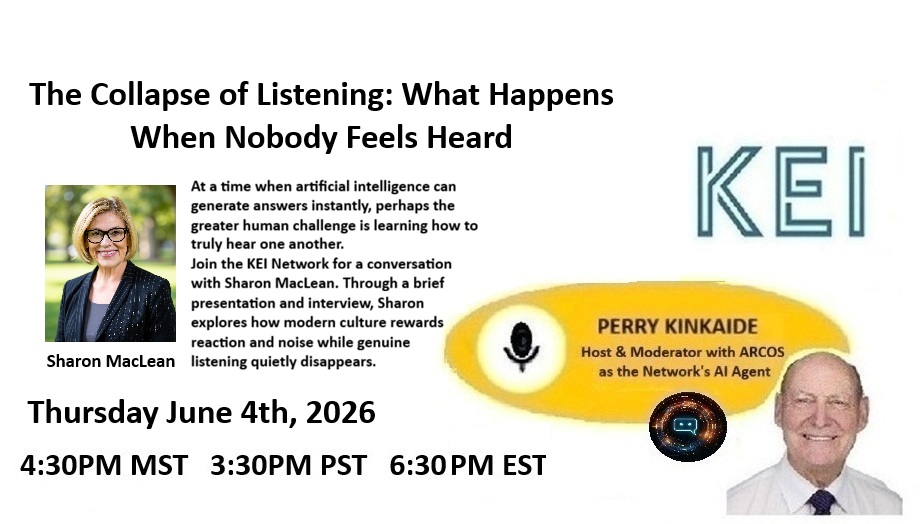
The Collapse of Listening: What Happens When Nobody Feels Heard In a world overflowing with information and constant reaction, the ability to truly listen may be quietly disappearing. This edition of the KEI Network newsletter explores The Collapse of Listening: What Happens When Nobody Feels Heard, featuring Sharon MacLean’s, article and associated webinar. While we have never possessed more tools for communication, many people increasingly feel ignored, misunderstood, or unheard. Modern culture rewards speed and reaction. As Sharon argues, meaningful listening, however, requires patience, curiosity, empathy, and the willingness to understand perspectives different from our own. Research shows most people believe they are above-average listeners, even though objective studies suggest otherwise. We often confuse hearing with listening and waiting to speak with understanding. At a time when artificial intelligence can increasingly generate answers, perhaps the greater human challenge is learning once again how to ask better questions — and how to truly hear the responses. The future of leadership, relationships, and citizenship may depend less on our ability to speak and more on our willingness to listen. – Editor P.S. Having an ear shot off may explain a lot. Also included HERE Humanity is not ready for AI is our Fact or Fiction companion. |
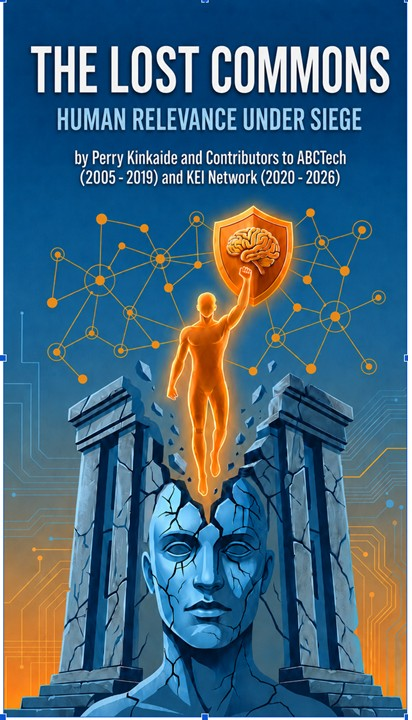
The Lost Commons: Human Relevance Under Siege 20 years. 1,000 voices. ONE book. Be among the first to experience the audiobook and the book's fall release
This early release is being shared with the KEI Network, many of whom participated in the 20-year journey. You'll receive priority access as soon as it becomes available, along with the opportunity to share your reflections. |

|
The Collapse of Listening: What Happens When Nobody Feels Heard Submitted by Sharon MacLean
Are we listening anymore — or simply planning a reply while someone else is speaking?Reaction is easier. It is immediate and emotional. Reflection is slower. It requires curiosity, restraint, and the willingness to sit with uncertainty long enough to understand another perspective.
I’ve grown weary of conversations where people interrupt not to understand, but because they assume they already know better. In an age of constant opinion, disruption, and distraction, real listening may be becoming a lost human skill. In contrast, staying present long enough to truly understand another person’s perspective before reacting is one of the simplest forms of showing respect. Continued below
No need to register. Just Zoom in https://us02web.zoom.us/j/84258596166?pw.. Continued from above Here’s my mantra: good listening feeds good thinking, which shapes better replies, speaking and writing.
Did We Listen Better Historically? Perhaps not perfectly. But modern life increasingly rewards reaction over reflection. Over the years, people often urged me to immediately post opinions after political events, breaking news stories, or emotional moments. I usually resist the prompt. My perspective is shaped by decades spent writing, editing, and designing content — from magazines and speeches to newsletters and social media campaigns — where I learned that thoughtful perspective is rarely improved by urgency.
There is also value in getting the facts straight. Sometimes wisdom comes from waiting to speak. There is benefit in reading broadly, considering multiple perspectives, debating ideas thoughtfully, and allowing opinions to form gradually rather than instantly.
The arrival of social media dramatically accelerated the pressure for immediate reaction. Don’t get me wrong. I value digital innovation and was an early adopter of both social media and Generative AI. Yet I still resist the pressure to instantly post outrage, certainty, or emotionally charged opinions. Perhaps that is why so much modern communication now feels performative rather than reflective.
Impatience also creates fertile ground for misunderstanding and error. What if we rewarded something else instead?
It is no surprise that today’s workplace is overloaded with emails, meetings, digital channels, and constant interruptions. Whether colleagues are truly listening to one another or not, many organizations now revolve around continuous communication. Entire days disappear into meetings while the real work is pushed into evenings and weekends — often without additional compensation. The modern workplace increasingly pressures people to:
At the same time, constant notifications, scrolling, podcasts, texts, and breaking news train our brains to shift attention rapidly rather than sustain deep focus.
Is anyone truly listening before responding? In workplaces, politics, and relationships, many people now listen defensively — preparing rebuttals instead of seeking understanding. Reaction is easier. It is immediate and emotional. Reflection is slower. It requires curiosity, restraint, and the willingness to sit with uncertainty long enough to understand another perspective. And perhaps that is what is quietly disappearing: not conversation itself, but the human capacity to genuinely hear one another. That may also explain why so many people no longer feel heard.
What About Different Styles of Listening? Not everyone listens in the same way. We’ve become aware that people process information differently. Greater understanding of neurodiversity — including dyslexia, ADHD, and other cognitive differences — is reshaping how we think about attention, engagement, and communication itself. For example, a dyslexic listener may lose the thread when information is delivered too quickly, too densely, or with excessive detail. A person with ADHD may disengage during a long meeting, training session, or conversation once interest or stimulation drops.
Does that mean they are not listening? Not at all. Many such individuals are capable of extraordinary focus and deep concentration when engaged in work that matters to them. They often become specialists — people who immerse themselves deeply in subjects they care about and develop exceptional expertise in their field. They may simply listen differently than the generalist.
So, listening is not only the responsibility of the audience. Effective communication also requires speakers to “listen” to the people in front of them — to read attention levels, energy, learning styles, curiosity, and engagement in real time. Here are examples of listening styles and their focus.
Why This Matters Now. As a society, we need thoughtful and emotionally intelligent leaders more than ever to understand a workforce that is changing before our eyes. Economic instability, war, climate change, global health challenges, and shifting social values are reshaping how people think about work, purpose, and one another. In many workplaces, this has triggered a reconfiguration of the social contract between employers and employees as both sides search for a new balance. At the same time, the bottleneck is no longer access to information — it is decision overload.
The most valuable skills may now be the most human ones: listening deeply, collaborating effectively, thinking critically, and showing compassion. Without those capacities, communication habits begin to erode relationships through conflict, defensiveness, disengagement, and decision fatigue. Here is what often happens when people no longer feel heard:
The real crisis is not that people disagree. It is that fewer people believe they are being genuinely heard. And when people stop feeling heard, they often stop listening back. Beyond Active Listening. Research increasingly recognizes that being ignored is a form of psychological harm and, in some contexts, emotional abuse. The human brain struggles more with vague rejection than clear disagreement. That’s why many therapists and leadership researchers say:
What People Remember About Good Listeners. Want to appear more thoughtful and intelligent? Show genuine curiosity about the people in front of you rather than focusing on getting your own opinions across. Remember names. Ask questions. Ask thoughtful follow-up questions. Most importantly, listen carefully to the answers.
Here are six additional listening practices that help people feel genuinely heard.
This might prevent employees from saying, “nobody listens” or “my manager never asks me another question.” Leaders who ask thoughtful follow-ups are perceived as more intelligent, more empathic, and more trustworthy. Conversely, ignoring, interrupting, redirecting, or failing to follow up often creates the opposite feeling:
People rarely feel heard after one question. They feel heard when someone stays curious.
Person A: “I had a really stressful week.” One-upper: “You think that’s stressful? You should see my week.”
The underlying message becomes: “Your experience matters less than mine.” That’s why people often leave these conversations feeling oddly lonely even though someone was talking to them the entire time.
Examples:
People often calm down once they feel accurately understood. Reflective listening reduces defensiveness and deepens conversation quality by studying the underlying meaning, not just the words.
Examples:
The first answer is often intellectual. The second or third answer reveals the emotional truth.
People rarely reveal themselves all at once; instead, patterns emerge gradually through words, reactions, and omissions.
Examples:
The future of communication may depend less on how quickly we respond and more on |