|
Editor - Perry Kinkaide |
Is Canada's SOVEREIGNTY At Risk? - Fragile and under Siege |
||
|
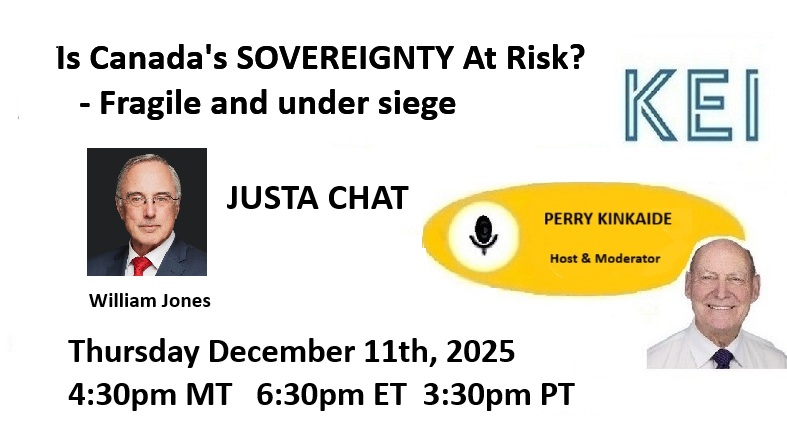
Canada’s sovereignty has always existed within America’s orbit—protected yet pressured by its proximity. As trade, defense, and AI integration deepen, partnership risks becoming dependency. This issue explores how Canada can “Get to Yes with the U.S." Sovereignty lies not in resistance but in resilience—in setting clear priorities, building domestic capacity, and maintaining cultural and strategic confidence. Alignment must be a choice, not a condition. The webinar on Thursday will explore the question of national Sovereignty from both an external and an internal perspective. Bill Jones - wise about the US:Canada relationship, will be joining me for JUSTA CHAT as we discuss his perspective and mine as gathered during my tour of the US West this fall and US East in the spring. Join us. |
|||

|
IS CANADA's SOVEREIGNTY AT RISK? - fragile and under siege
The Paradox of Proximity. Few nations are as closely bound — or as quietly constrained — as Canada is to the United States. We share the world’s longest undefended border, the largest trading partnership, and deep cultural ties. Yet the very intimacy of that relationship has blurred the boundaries of independence. Canada’s sovereignty, while formally intact, is often exercised within the gravitational pull of its southern neighbor — a reality both comforting and perilous.
The paradox of proximity is this: Canada’s success depends on access to the U.S. market, but its autonomy depends on distance from U.S. decisions. Navigating that line — between partnership and dependency — is the delicate art of “Getting to Yes” with the United States without losing ourselves in the process. Continued below
 Latest Webinar Recording SOVEREIGNTY of the SOUL introducing KEI's AI Agent
https://us02web.zoom.us/j/84258596166?pw.. William Jones - is a veteran entrepreneur with 40+ years in international business. advising governments, legal and financial institutions, airlines, real estate developers, and energy companies across Canada, the United States, and the Caribbean. A recognized change agent subject-matter expert for three decades, Bill has helped organizations navigate infrastructure, data, and communications at scale. He is currently developing the Alberta Economic Embassy (AEE), a next-generation data centre and innovation campus in Edmonton designed to anchor sovereign compute and industrial growth in Western Canada. Bill was recently invited by the KEI Network to speak and discuss sovereignty and Canada’s geopolitical positioning—especially Canada-U.S. relations. Continued from above The Economic Bind: Fortress North America or Economic Annexation? Nearly 75% of Canada’s exports flow south; 60% of imports come back north. Energy, minerals, and manufactured goods underpin a continental economy so integrated that even mild disruptions — tariffs, Buy American provisions, or cross-border blockades — send tremors through Canadian industries.
The 2025 U.S. Inflation Reduction Act, intended to secure domestic supply chains, has become both an opportunity and a trap. Canada is invited to participate, but only on American terms. As Ottawa aligns tax credits, defense contracts, and semiconductor policies with Washington, it risks transforming from partner to appendage — a supplier rather than a strategist in shaping continental priorities.
The lesson from history is sobering: economic sovereignty erodes not through conquest, but through convenience.
Defense and Dependency: Who Guards the Guardian? In defense, the story is much the same. Canada’s national security has long relied on U.S. protection — through NORAD, NATO, and shared intelligence alliances. Yet when security depends on another’s arsenal, strategy becomes subordinate.
Modern warfare is hybrid — cyber, space, and AI-driven. The United States now leads in every domain of digital defense, from satellite surveillance to quantum encryption. Canadian capacity, by contrast, remains underfunded and dependent. The risk is not invasion but irrelevance: that Canada’s defense posture becomes reactive, shaped by Washington’s definition of “threat.”
Sovereignty in the 21st century will hinge as much on cyber deterrence as on tanks. The question is whether Canada can defend not only its territory, but its algorithms.
The Cultural and Political Drift. The U.S. doesn’t just dominate trade and defense — it shapes culture, language, and discourse. Canadian news cycles mirror American ones. Political polarization and populism seep northward through digital media, eroding Canada’s historically pragmatic middle. In this sense, the threat to sovereignty is psychological. When identity becomes imported, governance follows. The more we imitate, the less we innovate.
The AI Alliance: Between Integration and Submission. Artificial intelligence may be the next test of continental sovereignty. While Canada was early to lead in AI research, the infrastructure and commercialization are now concentrated in the U.S. As American firms — OpenAI, Google, Anthropic — integrate into Canadian public institutions and enterprises, data flows southward and with it, influence.
The question isn’t whether to cooperate; it’s how. Integration is inevitable. Submission is not. “Getting to Yes” must mean defining what we say no to — the limits of alignment that preserve space for domestic innovation, policy independence, and cultural confidence.
The Path to ‘Yes’ Without Losing ‘Us’. The U.S. is not Canada’s adversary. It is our indispensable partner — and our greatest test. The challenge of sovereignty is not resistance but resilience: how to engage deeply without erasure. To “get to yes” with the U.S. requires a new mindset — neither deference nor defiance, but design. Canada must:
1. Define clear national interests — in AI, energy, defense, and trade — before negotiations begin.
2. Build domestic capacity — in compute, cybersecurity, and advanced manufacturing.
3. Leverage alliances — with Europe, Asia, and emerging partners to diversify influence.
4. Invest in identity — in education, media, and civic literacy, to reinforce what makes Canada distinct.
Sovereignty is not isolation. It is the ability to choose partnership on one’s own terms.
The Border Within. Canada’s border with the U.S. is not the 49th parallel — it runs through our economy, our technology, and even our minds. Getting to "Yes” with the US must not mean saying yes to everything or possibly anything. True sovereignty in this century will not be declared in Ottawa or Washington but demonstrated — in how Canada governs its data, defends its interests, and defines its own destiny. The question for Canadians is not whether to align with the U.S. — that’s a given. The question is not with the U.S. at all, but whether it is prepared to solve it's own problems first!
|
|||
 No need to register. Just Zoom in