|
Know Thyself HERE Editor - Perry Kinkaide Visit KEInetwork.net |
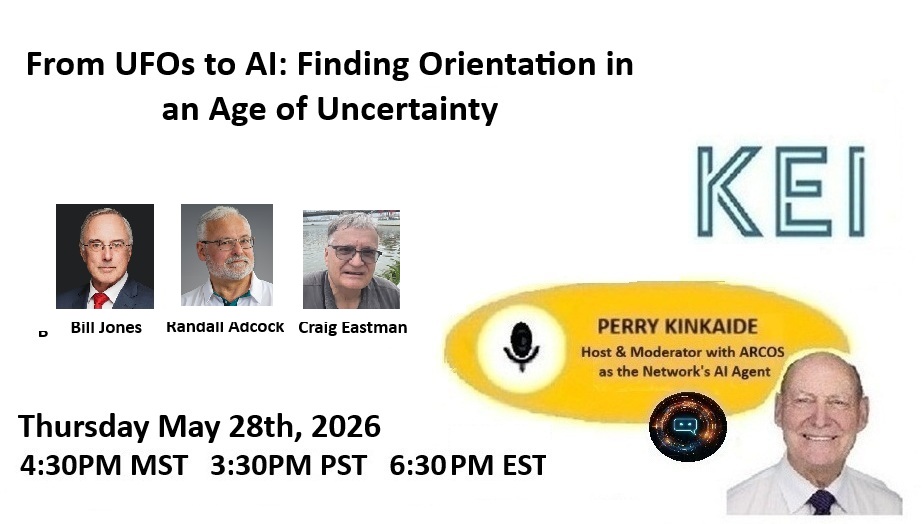
From UFOs to AI: Finding Orientation in an Age of Uncertainty Uncertainty - the unexplainable, is a fact of life. Sometimes it is extraordinary, impactful, even fearful. There is the benign and welcome experience of being "in the zone" in sports but there is also being witness to a ghost or a UFO. Civilization is being reshaped by the extraordinary convergence of the forces and sources of change including AI. At a personal level we are being exposed to increased uncertainty and fragmented realities. This week’s article explores how humanity can maintain orientation, humility, and shared understanding amid overwhelming complexity. Drawing on themes from The Last Commons, Randal Adcock examines why rebuilding trust, critical thinking, and meaningful dialogue may matter more than ever. This week's associated webinar features a couple of others invited to share and discuss their "unexplained experiences". - Editor Also included HERE Reolving Uncertainty is our Fact or Fiction companion. |
The Last Commons: Reclaiming Personal Sovereignty 20 years. 1,000 voices. ONE book. Be among the first to experience the audiobook edition of The Last Commons. This early release is being shared with the KEI Network, many of whom participated in the 20-year journey. You'll receive priority access as soon as it becomes available, along with the opportunity to share your reflections. |
 LAS
LAS
|
From UFOs to AI: Finding Orientation in an Age of Uncertainty
History never feels clear while we are living through it. The people of the Renaissance or Industrial Revolution did not know they were entering a new age. They experienced confusion, disruption, fear, and opportunity all at once. Our time is no different. The Crisis of Orientation. Artificial intelligence, social media, automation, biotechnology, and global networks are changing civilization faster than people and institutions can adapt. In the past, humanity struggled with too little information. Today, we struggle with too much.
Many people feel disoriented. Trust weakens. Public dialogue fragments. Social media and algorithms divide society into competing realities where emotion often matters more than truth. We are more connected than ever, yet increasingly isolated and uncertain about what is real, meaningful, or trustworthy. This is one of the central themes of The Last Commons: modern society is losing the shared spaces where people can think together, test ideas, and build trust across differences. Continued below
No need to register. Just Zoom in https://us02web.zoom.us/j/84258596166?pw.. Continued from above Living With Mystery. My own interest in uncertainty began early. As a child and later as an adult, I witnessed several unusual aerial phenomena that I could not fully explain. Whether those events had ordinary explanations or not became less important than the deeper realization: human beings sometimes encounter experiences beyond their current understanding. Those experiences did not push me way from science. They pushed me toward deeper questions about knowledge, consciousness, and the limits of human understanding.
At fourteen, after hearing Martin Luther King Jr. speak about prejudice, I began reflecting on how people form beliefs. Over time I came to a simple conclusion: the only thing we know directly is that we are conscious and thinking. Everything else is interpretation. That realization first felt unsettling. Later it became liberating. Human knowledge will always be limited, while reality itself may be far larger than we can fully grasp. That is why humility matters.
Skepticism Without Cynicism. The UFO debate reveals how societies often handle uncertainty poorly. Discussions became trapped between blind belief and automatic dismissal. Two principles remain important:
Together, they encourage a healthier mindset: skepticism without cynicism, openness without gullibility.
Modern science explains much, but many mysteries remain. We still do not fully understand consciousness, gravity, dark matter, or even why existence itself exists. As Albert Einstein observed, “The most beautiful thing we can experience is the mysterious.” Mystery should not weaken science. It should strengthen humility.
The Internet and the Collapse of Shared Reality. The internet connected billions of minds into a global network. Social media accelerated the spread of ideas, emotions, outrage, and tribalism. Humanity learned how to connect everything before learning how to interpret everything. Much of today’s polarization, conspiracy thinking, and institutional distrust may come from a civilization overwhelmed by complexity. People retreat into ideological tribes because echo chambers simplify reality and provide emotional stability.
All human knowledge is incomplete. Every model, ideology, institution, and AI system highlights some things while ignoring others. Bias is not just political prejudice; it is a natural limit of finite human thinking. The real challenge is not eliminating uncertainty. It is learning how to think better within it.
AI and the Future of Civilization. Artificial intelligence now intensifies these problems. The web connected humanity. Social media amplified humanity. AI is accelerating humanity. The greatest danger may not be hostile machines. The greater danger is amplifying intelligence faster than wisdom. Without stronger critical thinking, systems awareness, and public dialogue, AI could deepen confusion, manipulation, dependency, and fragmentation. But AI could also help humanity better understand complexity and solve problems beyond individual human capacity. The outcome depends less on technology itself than on the maturity of the civilization using it.
Rebuilding the Commons. Healthy societies require balance: skepticism and imagination, stability and adaptation, order and exploration. Too much rigidity creates dogma. Too much uncertainty creates fragmentation. That is why The Last Commons matters. Civilization may need new commons: places where people can think together without ridicule, propaganda, or algorithmic tribalism.
The future may depend not simply on becoming more intelligent, but on becoming wiser about how we think, learn, and live together. Humanity does not merely need more information. Humanity needs better ways of thinking about thinking itself. |
|
|
|
 Randal Adcock