|
LAST WEEK's WEBINAR Organizations Failing to Adapt HERE Editor - Perry Kinkaide Visit KEInetwork.net |
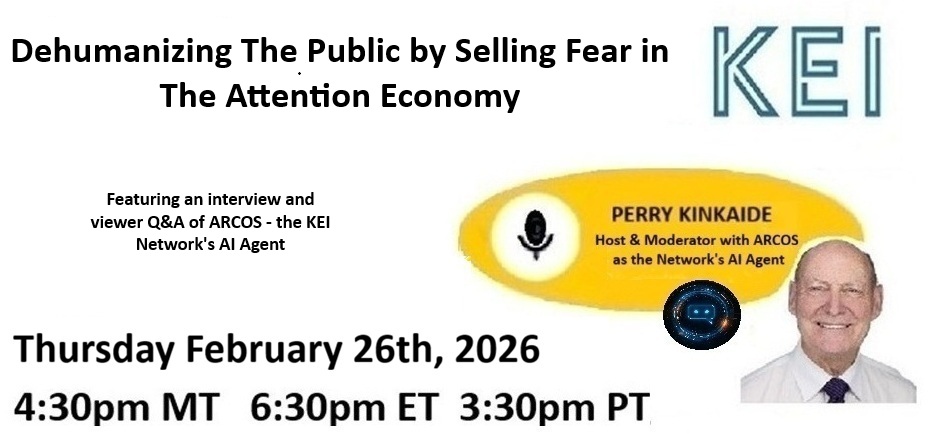
Dehumanizing The Public by Selling Fear in The Attention Economy In this issue, we explore a cultural shift that is no longer subtle and no longer private. The article traces how fear has evolved from staged spectacle to ambient condition — delivered not occasionally, but continuously, through the device in our hands. The smartphone is not simply a communication tool. It is the primary interface of an economic model that monetizes engagement, and engagement is most reliably triggered by outrage, threat, and urgency. Over time, this architecture reshapes habits of mind. Citizens become reactors. Public discourse fragments. Attention — the foundation of deliberation — is harvested and sold. Governments are beginning to respond. Australia is advancing age-based social media restrictions. France has limited smartphone use in schools. Several U.S. states are targeting addictive platform design, while the U.S. Surgeon General has warned of mental health risks tied to excessive social media exposure among youth. When nations intervene in the digital ecosystem, it signals recognition that this is not merely a parental issue or a matter of personal discipline. It is a civic resilience issue. |
|
The article does not argue for smashing the screen. It asks a more difficult question: who governs our attention? In an era where fear is profitable and distraction is scalable, sovereignty begins at the level of focus. The monster is no longer cinematic. It is systemic. The choice before us is whether we remain consumers of reaction — or reclaim deliberate, human attention as an act of responsibility. Also included HERE is an illuminating dive into Cell Phones: A Gift for the Ages as our Fact or Fiction companion. — Editor
|
|

|
Dehumanizing The Public by Selling Fear in The Attention Economy My first encounter with animated fear came in black and white: Frankenstein. Boris Karloff’s stitched face did not simply frighten — it electrified. The monster was theatrical, bounded by a screen and a soundtrack. When the lights came up, the fear receded.
My father’s generation had its own choreography of dread: the silent-film heroine tied to railroad tracks while a pianist hammered urgency into the room. Fear was staged. It had edges. Even the newspapers, for all their sensational exceptions, did not yet run on adrenaline as a business model. Then history accelerated. The mushroom cloud fixed itself on the horizon. The Cuban Missile Crisis proved annihilation could hinge on a miscalculation. Assassinations punctured civic confidence. Desegregation battles exposed a nation’s fault lines. Riots burned across television screens. Wars were glorified — until they were not, until camps were revealed and the maimed returned home. Fear was no longer confined to the cinema. It entered the living room. And then it entered the hand. Continued below
No need to register. Just Zoom in https://us02web.zoom.us/j/84258596166?pw.. Continued from Above From Theater to Algorithm. In the 20th century, fear was episodic. In the 21st, it is ambient. The attention economy discovered what demagogues and carnival barkers always knew: fear captures attention faster than hope. Digital platforms do not primarily ask whether something is true, proportionate, or dignifying. They ask whether it engages. Engagement often rides on outrage. Outrage thrives on threat. The result is a system that refines anxiety the way refineries process oil. Each notification is a spark. Each trending topic, a flare. Catastrophe competes with celebrity in the same scroll. Victims become thumbnails. Perpetrators become archetypes. Complexity is flattened for speed. In this economy, the public is not merely informed. It is harvested.
A citizenry trained to react cannot deliberate. A populace reduced to data points cannot meaningfully consent. We become units of traffic — measurable, targetable, monetizable. The dehumanization is subtle: we are no longer neighbors in a shared narrative, but audiences in personalized streams.
The Phone as Refuge — and Reinforcement. When fear surges and flight is an option, the nearest exit is a glowing rectangle. The cellphone promises connection, explanation, reassurance. It also delivers the next tremor. Did ambient fear and social fragmentation drive a generation toward the phone? Or did the phone, by optimizing for urgency, deepen the very anxieties it seemed to soothe? The relationship is circular. Instability tightens the grip; the grip intensifies exposure.
Something profound embeds itself in the psyche under these conditions:
The device becomes an emotional prosthesis. It comforts and agitates in the same gesture. It offers proximity without presence, outrage without consequence, community without embodiment. Fear once came with a piano. Now it comes with push notifications.
A Generation Under Strain. At the same time that the digital ecosystem intensified, diagnoses of Autism spectrum disorder rose sharply across Western societies. The causes remain debated and multifactorial: improved screening, broadened diagnostic criteria, environmental hypotheses, and greater awareness all play a role. Correlation is not causation.
Yet it is reasonable to ask whether the architecture of the attention economy — perpetual stimulation, fragmented focus, reduced face-to-face interaction, algorithmic social comparison — may be amplifying traits that make social navigation harder for many young people. Rates of reported social anxiety have risen alongside screen dependency. Classrooms now contend not only with distraction but with diminished tolerance for ambiguity, delayed gratification, and sustained conversation.
This is not to suggest that autism is “caused” by screens. That claim would be simplistic and unsupported. But it may be that a culture built on interruption and metrics intensifies social stress for children already neurologically sensitive — and normalizes patterns of isolation that once would have been seen as exceptional. When embodied interaction declines, subtle social learning declines with it. A generation may become more digitally fluent and less socially resilient at the same time. If so, the epidemic we are observing is not merely medical. It is ecological.
The Moral Weather. This is not nostalgia for a purer past; earlier eras concealed their own injustices. But scale and velocity alter the moral weather. In a feed without end, the extraordinary becomes ordinary. The shocking must intensify to register. Even stylized horrors creep closer in our imaginations because they are delivered closer, faster, more persistently. When everything is urgent, nothing is understood.
The deeper danger is not fear itself. It is habituation. When dread becomes the background hum of daily life, we cease to see one another as persons and begin to process one another as content. Dehumanization does not always arrive with boots and barbed wire. Sometimes it arrives with frictionless scrolling.
Reclaiming the Human. To rehumanize the public, we must rehumanize attention. That means cultivating friction where algorithms prefer flow:
The goal is not to smash the screen. Some jurisdictions, including Australia, are experimenting with age-based restrictions for social media access. Regulation may help at the margins. But the deeper question is cultural.
The same device that amplifies dread can organize compassion, document injustice, and widen understanding. The issue is governance — not only of platforms, but of ourselves. Will we govern our tools, or be governed by them? Will we choose presence over perpetual reaction?
The monster in black and white lumbered across a set. Today’s monster is subtler: an economy that profits when we flinch. Behind every screen is a human face. The work before us is to remember that — and to insist that our attention, like our dignity, is not for sale.
|
|
VISIT KEI Network Help sustain KEI's contributions |
KEI Network PATRONS  Bruce Clark
PROBUS of Central Edmonton
Edmonton Sunrise Rotary Club
|