|
Editor - Perry Kinkaide Visit KEInetwork.net |
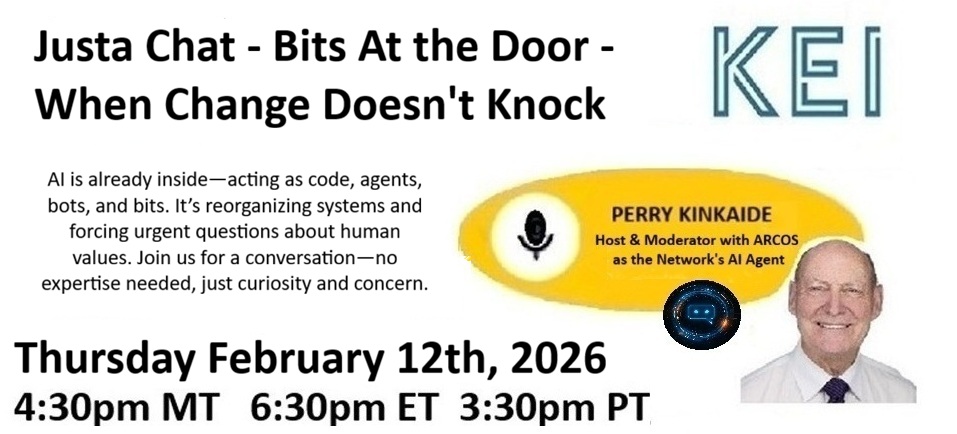
Bits At the Door - When Change Doesn't Knock In moments of disruption, attention naturally fixes on what is loud, visible, and dramatic. History suggests we should be more wary of what is quiet.
Civilizations are rarely undone by threats that announce themselves. They are more often reshaped by forces that arrive incrementally, integrate smoothly, and become indispensable before their consequences are fully understood. That distinction frames this week’s featured editorial, “Bits At the Door - When Change Doesn't Knock?”
Rather than focusing on the familiar imagery of bots and automation, the article examines a subtler transformation already underway: the systematic re-engineering of cognitive work itself. AI is not storming the gates. It is being invited inside—through productivity tools, decision systems, and “assistants” that quietly absorb judgment, synthesis, and expertise. The early effects are easy to dismiss. The long-term implications are not.
The concern raised here is not fear of technology, but fear of complacency. If good-paying cognitive work erodes faster than institutions adapt, the consequences will not announce themselves until the choices are already made.
|


|
Bits At the Door - When Change Doesn't Knock
Bots get the attention. Bits do the damage. History teaches us to watch the gates. When civilizations fall behind, the danger is often imagined as external and obvious—armies, invasions, or visible shocks that force an immediate response. But the more consequential disruptions are frequently quieter. They arrive not with spectacle, but with systems—incremental, rational, and difficult to oppose once embedded.
That is the moment we now face with artificial intelligence.
This KEI editorial was stirred by a recent Behind the Curtain article from Axios, which posed a deceptively simple question: Is AI already destroying white-collar jobs—or is something much larger quietly forming beneath the surface? Their conclusion was not alarmist, but it was unmistakably cautionary. While there is little evidence of mass job destruction today, five converging developments suggest that the foundations of white-collar work are being systematically re-engineered. Continued below
No need to register. Just Zoom in https://us02web.zoom.us/j/84258596166?pw.. Contnued from above Among them: credible estimates that AI could automate roughly a quarter of all work hours; the emergence of AI systems that now build tools to replace routine professional tasks; firms training AI directly on human expertise at scale; declining reliance on skilled immigration as companies anticipate AI substitution; and senior technology leaders openly questioning the future value of entire professions. In short, the Axios article did not argue that the barbarians have arrived. It argued that the infrastructure for replacement is being quietly assembled.
That distinction matters.
The public conversation about AI remains fixated on bots—robots on factory floors, humanoid machines, or visible automation displacing manual labor. These images are tangible, cinematic, and politically convenient. They give us something to point at, regulate, or delay.
They arrive through productivity tools, decision-support systems, workflow automation, and “assistants” that slowly absorb judgment, synthesis, and execution. The early casualties are not assembly-line workers, but analysts, coordinators, junior professionals, and eventually credentialed experts whose value was once rooted in specialized knowledge and pattern recognition.
What makes this moment uniquely destabilizing is not just the technology—but the silence surrounding it.
Despite mounting private concern among executives and policymakers, there is little serious public debate about how societies should respond if good-paying cognitive work begins to erode faster than new roles emerge. The Axios article notes that political leaders across the spectrum appear hesitant, uncertain, or unwilling to confront the issue directly. Not because it is hypothetical—but because it is structurally difficult to solve.
History suggests that technology eventually creates more jobs than it destroys. But history also shows that transitions without preparation produce inequality, social strain, and institutional decay. The question is not whether AI will reshape work—it already is. The question is whether governance, education, and civic institutions will adapt deliberately, or drift reactively.
Some leaders argue that AI will solve labor shortages and unleash new opportunity. Perhaps they are right. Or perhaps that confidence will age poorly, preserved as a quotation in a future time capsule. KEI’s concern is not rooted in fear of technology. It is rooted in fear of complacency.
Fact or Fiction? The fiction is that this can be postponed until the evidence is undeniable. The fact is that by the time it is undeniable, the choices will already have been made. The door is not being kicked in. It is being quietly opened. We are the perpetrators of the dreaded 1984, except it’s bots not Big Brother that is taking control. For more, read today's Fact or Fiction article AI's Enlightment - To Embrace Humanism |

|
VISIT KEI Network Help sustain KEI's contributions |
KEI Network PATRONS  Bruce Clark
PROBUS of Central Edmonton
Edmonton Sunrise Rotary Club
|