|
LAST WEEK's WEBINAR When Democracies Stop Listening YouTube recording deferred to next week Editor - Perry Kinkaide Visit KEInetwork.net |
Alberta's Sovereignty Challenge - AI, Diversification and Commercialization As Alberta debates sovereignty, separation, and its future relationship with Canada, most discussion centers on politics, constitutional authority, and jurisdiction. Yet a more fundamental question often goes unasked: What truly makes a society sovereign? Political authority alone does not create resilience. Economic strength, diversification, innovation, ownership, and the capacity to adapt to change are equally important. A province that depends heavily on a single industry, customer, technology, or source of wealth remains vulnerable regardless of its constitutional status. In this article, the author argues that artificial intelligence is accelerating economic change and challenging traditional assumptions about prosperity and competitiveness. Alberta's future may depend less on the resources it possesses and more on its ability to commercialize innovation, develop new markets, retain ownership of intellectual assets, and build a more diversified economy. Whether one supports greater autonomy, renewed federalism, or separation, the central challenge remains the same: How can Alberta convert today's prosperity into tomorrow's resilience? The answer may have less to do with politics than many assume. This article explores why diversification, commercialization, and artificial intelligence have become central to Alberta's long-term economic security. These themes will also be examined in greater depth during the accompanying KEI Network webinar, where participants will discuss the opportunities, risks, and policy choices shaping Alberta's future. - Editor Also included HERE Canada's Innovation Problem is Technology is our Fact or Fiction companion. |
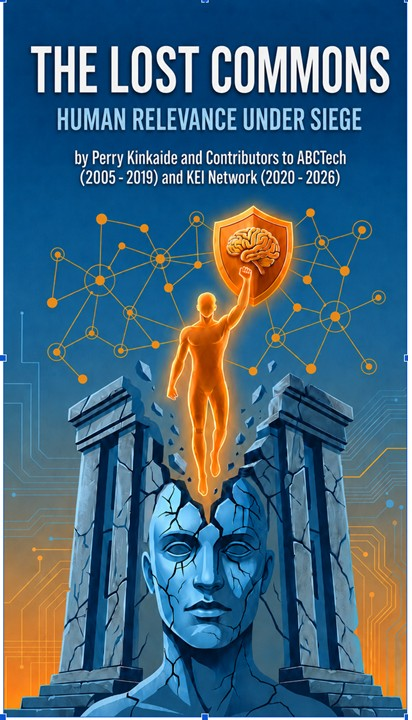
The Lost Commons: Human Relevance Under Siege 20 years. 1,000 voices. ONE book. Be among the first to experience the audiobook and the book's fall release
This early release is being shared with the KEI Network, many of whom participated in the 20-year journey. You'll receive priority access as soon as it becomes available, along with the opportunity to share your reflections. |

|
Alberta's Sovereignty Challenge - AI, Diversification and Commercialization Alberta stands at a historic crossroads. For decades, the province has built extraordinary prosperity through natural resources, industrial expertise, engineering talent, and entrepreneurial ambition. Its vast energy reserves helped create one of the highest standards of living in the world and remain a strategic asset of enormous importance. Yet prosperity alone does not guarantee resilience. The question confronting Alberta today is not whether energy matters. It does. Nor is it whether Alberta should abandon the industries that built its success. It should not. The real question is whether Alberta can transform today's prosperity into tomorrow's resilience. This distinction matters because genuine sovereignty cannot be built upon a single resource, regardless of how valuable that resource may be. A province whose prosperity depends heavily upon forces beyond its control remains vulnerable, no matter how much political authority it possesses. Continued below
No need to register. Just Zoom in https://us02web.zoom.us/j/84258596166?pw.. Continued from above A society dependent upon one commodity, one industry, one customer, one technology, or one source of wealth remains vulnerable to forces beyond its control. Markets change. Technologies evolve. Political priorities shift. Competitors emerge. Global disruptions occur. Sovereignty, therefore, is not merely political. It is the capacity to absorb shocks, adapt to changing conditions, and continue prospering despite uncertainty. In economic terms, resilience is sovereignty made practical. For years, the former Alberta Council of Technologies and later the KEI Network argued that Alberta's greatest challenge was not resource extraction itself, but the ability to convert resource wealth into a diversified, adaptive, knowledge-based economy. Today, artificial intelligence has made that challenge more urgent than ever. Invention Is Not Commercialization. One of Alberta's persistent weaknesses is the tendency to confuse invention with innovation, and innovation with commercialization. Universities, research institutions, and government programs often measure success through patents, publications, prototypes, grants, and technical breakthroughs. These achievements matter. Markets, however, do not reward technology simply because it exists. Commercial success depends upon understanding customers, solving real-world problems, building trust, creating distribution channels, securing early adopters, and scaling solutions effectively. Too often, Alberta produces technology searching for a market rather than innovations driven by market demand. Artificial intelligence magnifies this challenge. As AI lowers the cost of creating products and services, technical capability becomes less scarce while competitive advantage increasingly shifts toward customer understanding, trust, relationships, and execution. The future will belong not simply to those who invent, but to those who commercialize. AI Changes the Nature of Advantage. The industrial economy rewarded scale, infrastructure, capital investment, and control of physical resources. The AI economy rewards adaptability, learning speed, creativity, networks, and collaboration. Information itself is becoming abundant and inexpensive. What remains scarce are distinctly human capabilities: judgment, empathy, leadership, trust-building, communication, and creativity. This reinforces a central lesson from the KEI perspective: commercialization is ultimately a human challenge rather than a technical one. AI can generate code, analyze data, draft reports, and automate countless tasks. It cannot create genuine trust, replace human relationships, or substitute for leadership and shared purpose. As automation expands, these human qualities become increasingly valuable. The Missing Demand Side. Alberta's innovation ecosystem has traditionally focused on supply. Governments fund research. Universities generate discoveries. Accelerators support startups. Investors search for opportunities. Yet one critical question often remains unanswered: Who will buy the innovation? Without customers, commercialization fails. Many promising Alberta technologies struggle not because they lack technical merit, but because they cannot secure early market validation. Governments, health systems, municipalities, educational institutions, and major corporations frequently fail to act as first adopters. As a result, startups seek customers elsewhere, investors become cautious, growth slows, and intellectual property migrates. Diversification therefore requires more than supporting inventors. It requires creating markets. The most successful innovation ecosystems understand that customers are every bit as important as inventors. The Sales and Marketing Gap. Alberta's economy has traditionally celebrated engineers, builders, geologists, scientists, and technical experts. Their contributions have been enormous. Yet commercialization depends equally upon understanding people. Sales, marketing, communication, positioning, relationship-building, negotiation, and customer engagement often receive far less attention than technical development. In the AI era, this imbalance becomes even more problematic. Products can increasingly be developed quickly and inexpensively, making trust and customer understanding the primary differentiators. The province therefore needs to elevate commercialization expertise to the same level of prestige as technical expertise. Prosperity will increasingly belong to those who understand unmet human needs and respond effectively to them. Fragmented Systems Cannot Compete. Knowledge economies thrive through connectedness. Yet Alberta's innovation ecosystem often remains fragmented. Universities operate separately from industry. Small businesses struggle to navigate procurement systems. Rural communities remain disconnected from urban innovation networks. Organizations compete for funding rather than collaborating. The result is duplication, inefficiency, and lost opportunity. Innovation emerges from relationships. Artificial intelligence increases the value of networks because access to information matters less than access to trusted collaboration. Alberta requires a true "network of networks" that connects researchers, entrepreneurs, investors, Indigenous communities, municipalities, industry leaders, educators, and citizens. Resilience emerges from connected ecosystems, not isolated institutions. Resilience Requires Distributed Prosperity. Economic resilience cannot be concentrated solely in Calgary and Edmonton. The digital economy allows smaller communities to participate in global markets through advanced agriculture, remote work, specialized services, clean technology, tourism, manufacturing, and digital entrepreneurship. A resilient Alberta distributes opportunity. Centralized economies may be efficient, but they can also become fragile. Diversified regional economies spread risk, increase adaptability, and strengthen communities. This is not simply economic policy. It is resilience strategy. Ownership Matters. Commercialization is about more than creating innovation. It is about retaining ownership of the value that innovation creates. Alberta has often generated promising companies only to see them acquired early by larger external organizations. Headquarters move. Intellectual property migrates. Strategic control follows. In Alberta's current sovereignty debate, questions of political jurisdiction often dominate the discussion. Equally important, however, is economic jurisdiction. Who owns the intellectual property? Who controls the platforms? Who captures the value created by innovation? These questions may ultimately prove as important as constitutional arrangements. In the age of AI, ownership increasingly involves data, platforms, algorithms, intellectual property, and decision-making capability. Long-term sovereignty requires more than creating value. It requires retaining sufficient control over that value to influence the province's future direction. The Human Foundation of Economic Success. At its deepest level, diversification is not merely an economic issue. It is a social issue. Commercialization depends upon trust, collaboration, leadership, civic engagement, institutional credibility, and the willingness to learn continuously. Polarization, fragmentation, bureaucratic silos, and declining trust weaken innovation because they undermine collective problem-solving. AI cannot solve those problems. Indeed, it may intensify them. As knowledge becomes abundant and automated, wisdom becomes increasingly important. The societies that prosper will not necessarily be those with the most advanced technologies. They will be those capable of sustaining trust, creativity, adaptability, and collaborative learning. The Sovereignty Question. The greatest risk facing Alberta is not a shortage of resources, talent, intelligence, or entrepreneurial ambition. Its greatest risk is complacency. The sovereignty debate now unfolding across Alberta reflects a legitimate desire for greater control over the province's future. Yet sovereignty is not merely a constitutional question. It is also an economic, technological, and social one. Diversification is often discussed as an economic objective. In reality, it is a resilience strategy. Its purpose is to ensure that Alberta can withstand future shocks regardless of where they originate—commodity markets, technological disruption, geopolitical conflict, environmental change, or economic transformation. A sovereign society cannot depend indefinitely upon a single source of prosperity, no matter how successful that source may be today. The world's fourth-largest energy reserve may fuel Alberta's economy today. But Alberta's future security depends upon building multiple sources of strength. The challenge, therefore, is not to replace energy. It is to complement it. Political sovereignty may determine who makes decisions. Economic resilience determines whether those decisions matter. The future will belong to jurisdictions capable of transforming today's wealth into tomorrow's resilience, converting innovation into commercialization, and building economies that can adapt, endure, and prosper in an age of continuous change. That is the real diversification challenge. And that is the essence of sovereignty. Is anybody listening? - Editor
|